
Click the link below the picture
.
It was well before dawn when I set off on foot through Granada’s oldest neighborhood, El Albaicín, an intricate brocade of cobbled streets overhung with fragrant jasmine trees. The first glow of sunlight revealed the titanic walls and turrets of the palace-fortress complex called the Alhambra looming above me on a spectacular crag. Poets have rhapsodized about the structure’s fairytale beauty since the finest craftsmen of the Arab world built it nearly 800 years ago. For over two centuries in the Middle Ages, it was the crown jewel of the Emirate of Granada, which stretched across Spain’s Mediterranean coast from modern-day Gibraltar past the snowcapped Sierra Nevada.
After crossing a stone bridge over the River Darro, I took a little-known back route into the palace called Cuesta del Rey Chico, a steep foot trail squeezed into a leafy ravine where the only sound was the water cascading from antique terra-cotta pipes. By now, the morning sunlight was making the Alhambra live up to its original name, al-Qal’ah al-Hamra, “the red fort.” An ornate archway led into the complex itself, an array of palaces and gardens covering 35 acres. The most famous site is the Nasrid Palace, named after the ruling dynasty. On my first visit, I had hardly known where to rest my eyes as I wandered its gorgeous chambers adorned with latticework and geometric patterns, its elegantly proportioned courtyards with burbling fountains, and the surrounding rose and orange gardens. Its interior walls are covered floor to ceiling with carved script in classical Arabic, which scholars have translated as praise for Allah, snippets of poetry and celebrations of the Nasrid rulers.
But on this morning’s visit, I was heading for a more mysterious world: the Alhambra’s secret network of underground tunnels and chambers.
At least, that was my hope. The Alhambra is the most popular attraction in Spain, drawing over two million visitors annually. It’s also one of the most strictly controlled thanks to its status as an Islamic outpost seized by Christians, which still has political overtones more than five centuries later. Gaining permission to visit its off-limits subterranean sections had been challenging. After emailing palace officials for weeks without response, I had already arrived in Granada when they bluntly denied my request. But then, suddenly, they reversed track. I received an urgent phone call: I had been approved to visit at 9 the next morning.
After reporting at a special office to fill out a string of forms, I cooled my heels for a half-hour in the company of an affable security guard named Jaime, who was wearing an earpiece, aviator sunglasses, and a black blazer with a green “A” sewn onto his lapel. Finally, Ignacio Martín-Lagos, a conservation officer, arrived and declared that he would be my Virgil to the palace’s subterráneo, a dimension of the complex that he said holds a special fascination for him. “The artistic beauty of the Alhambra aboveground is undeniable,” Martín-Lagos said in Spanish as we hopped over a metal barrier and walked along the fortress’s defensive walls. “But the most surprising thing is what lies below. It was really two structures. Only if you explore its subterranean levels can you grasp the palace’s true dimensions and understand how its day-to-day life really functioned.”
After passing a 40-foot drop without guardrails, which was not for the vertiginous, we arrived at the Torre de las Gallinas, or Tower of the Hens, where Martín-Lagos fished from his pocket a thin, six-inch-long master key. “You’re going to pass through the entire palace, but underground,” he said. After shouldering open a portal, he used his smartphone flashlight to guide us down worn stone steps into a labyrinth of tunnels and chambers once used by guards and staff. They were chilly, claustrophobic, and, when Martín-Lagos turned off the light, sepulchral. But the underground was once teeming with activity, he said. “The Alhambra was a palace-city. As well as soldiers, it had about a thousand civilian inhabitants to serve the royal family—cooks, bakers, cleaners—who could go back and forth down here, without bothering the sultan. You need to have a double perspective: the ornamental world above versus the practical world below.”
I began to realize that the Alhambra most visitors see, like the Palace of Versailles and the great British manor houses, required an elaborate hidden support system. The upstairs palace offered exquisite luxury, where the sultan lounged on silk pillows and ate slices of oranges and honey cakes. Downstairs was penumbral darkness broken by flickering torches, where the staff toiled unseen to seamlessly maintain the opulence. The security purpose of the tunnels was also crucial, Martín-Lagos added, pointing up at the ceiling. We were under the room where the sultan held his audiences. “Squadrons of soldiers were lined up here, ready to rush upstairs at a moment’s notice.” Nearby was a stairway that had only been discovered after a 1907 landslide, with 200 steps descending to a door hidden in the fortress walls. We then ascended and opened a trapdoor to a bell-shaped chamber with walls of raw stone that had been converted from a grain silo to a dungeon. (Prisoners were lowered 20 feet from the surface by rope, so it was impossible to escape.)
The grand finale was Martín-Lagos’ favorite site. As travelers at an outdoor café in a palace courtyard snapped photographs, he unlocked two panels of a metal trapdoor in the ground and heaved them open, sending up clouds of dust. “Take care!” he said, now pointing a hefty light down a tight spiral staircase. “Take lots of care!” The electric beams cut through the darkness to reveal a vast cistern, including an ancient bucket suspended by a rope and encrusted with skeletal algae. “The major problem of the Alhambra was water,” Martín-Lagos whispered in awe. “Enormous cisterns were needed to supply the palace and its huge staff.” According to Martín-Lagos, the German traveler Hieronymus Münzer saw this cavern in 1494 and declared that it was bigger than the cathedral in his home city. “We all know that the finest engineers in history were the Romans,” he said. “That’s undeniable. But we must acknowledge the technical skill of the Spanish Muslims.”
.
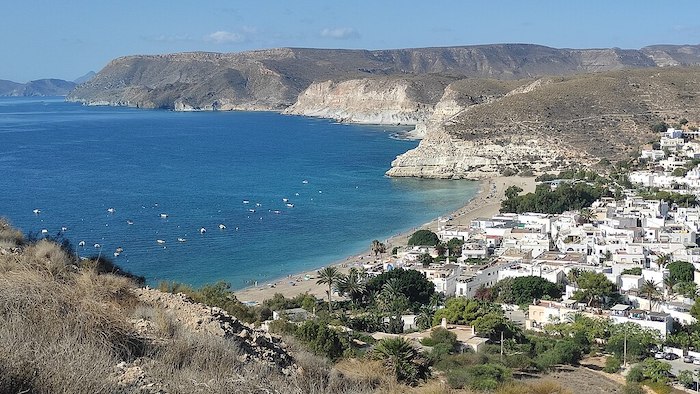 Agua Amarga (Public domain via Wikimedia Commons)
.
.
Click the link below for the complete article:
.
__________________________________________
 James' World 2
Leave a comment