
Click the link below the picture
.
A constitutional winter is upon us, partly enabled by last summer’s spike in the price of eggs. While the Federal Reserve battled egg inflation, angry voters reinstalled Donald Trump in the White House. Among his first acts: appointing two tech billionaires, Elon Musk and Vivek Ramaswamy, as efficiency czars. What their Department of Government Efficiency (DOGE)—more an advisory group, really—proposes to do, however, involves constitutional gambits that would rob James Madison, the “father of the Constitution,” of sleep.
Trump rode to victory attacking grocery costs and convincing voters that government was wasteful and that he alone could fix their grievances. His supporters included people fed up with Bidenomics and administrative snafus, everyday bureaucratic mazes that waste time, money, and patience.
Incoming presidents have often promised to address such snafus. Most famously, former president Bill Clinton, with his vice president, Al Gore, launched a “reinventing government” initiative that sought solutions from career public servants even as the initiative trumpeted basic business principles.
In stark contrast, Trump’s first-term agenda of “deconstructing the administrative state” failed in its ultimate goal of making key federal positions at-will hires to somehow deliver better government. Through DOGE, Trump will try again to overhaul the bureaucracy, this time with the help of business people whose ideas about the Constitution presage lengthy court battles.
In November, what appeared as the DOGE plan in the Wall Street Journal revealed a fundamental misunderstanding of public administration. Rather than addressing administrative snafus with a scalpel, DOGE risks creating constitutional ones with its axe.
DOGE’s lip service to eliminating “waste, fraud and abuse” thinly veils an agenda aimed at dismantling corporate watchdogs, from the EPA to the FDIC, and politicizing agencies like the DOJ and IRS to pursue presidential ends, without constitutional guardrails. This approach threatens the delicate constitutional balance that has sustained the Republic for over a century, dividing power among the three branches and the nonpartisan bureaucracy in their midst.
To nurture this balance, DOGE could consider mission-driven recommendations from the good government community of public administration scholars and nonpartisan research groups like the National Academy of Public Administration. They routinely investigate the best ways to make government more efficient and effective. Their past research findings can improve hiring, program implementation, cost management and other administrative techniques. These could have real, positive impacts on government efficiency while still allowing Trump to leave a positive legacy on the civil service. Plenty of these initiatives are already moving bureaucracy away from its technocratic, often snafu-riddled proceduralism to a more publicly engaged demonstration of outcomes.
Instead, the DOGE blueprint blatantly ignores Congress—even with GOP control—and champions the “unitary executive” theory of government by presenting normal bureaucratic rulemaking as a supposed scourge of democracy. Overstretching the summer’s Supreme Court rulings in West Virginia v. EPA and Loper Bright Enterprises v. Raimondo, the DOGE blueprint assumes that this executive, backed by a sympathetic judiciary, can “drive action” through reorganization, rule nullification, and impoundments.
.
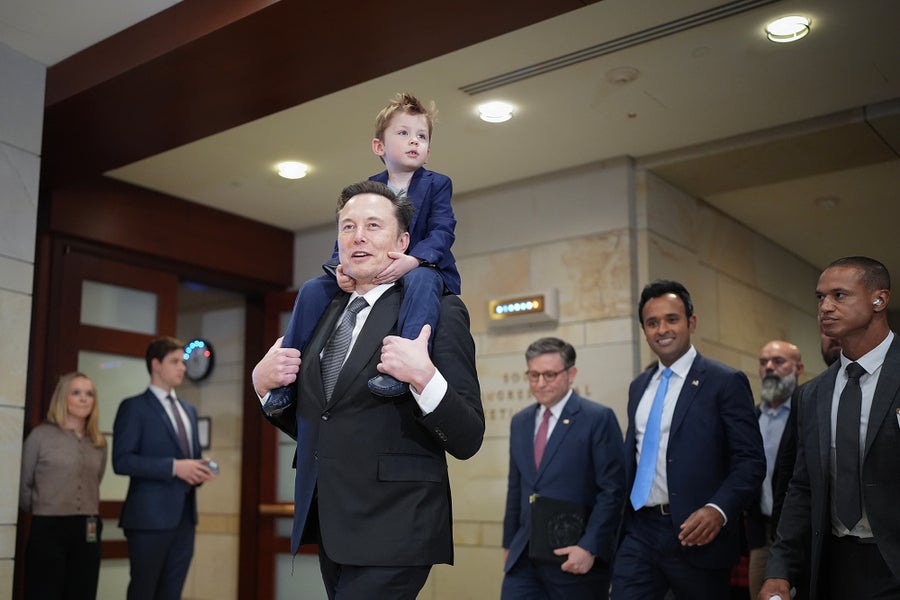
Tesla CEO Elon Musk, co-chair of the newly announced Department of Government Efficiency (DOGE), carries his son X on his shoulders at the U.S. Capitol after a media availability with businessman Vivek Ramaswamy (third from right). Andrew Harnik/Getty Images
.
.
Click the link below for the complete article:
.
__________________________________________
 James' World 2
Leave a comment