
Click the link below the picture
.
Imagine that the next time you catch a stomach bug and antibiotics fail to work, you knock back a vial of clear liquid. The solution teems with bacteriophages, viruses resembling tiny rocket ships. These benign microbes exclusively dock onto and destroy bacteria, and your infection clears in a matter of days. Such a future is within reach, journalist Lina Zeldovich writes in her new book The Living Medicine: How a Lifesaving Cure Was Nearly Lost―And Why It Will Rescue Us When Antibiotics Fail. The book chronicles the history of a decades-old, sometimes finicky approach to infection that U.S. science has long dismissed in favor of antibiotics.
As microbes develop cleverer and cleverer ways to evade antibiotics, some scientists have returned to bacteriophages, scooping them from wastewater and testing their pathogen-killing abilities in the laboratory and clinic. Experimental trials are now underway to test bacteriophage therapies against superbugs such as Shigella, vancomycin-resistant Enterococcus, and a strain of Escherichia coli implicated in Crohn’s disease. And some food industry producers already use Food and Drug Administration–approved “phage sprays” to decontaminate their supply of, say, lettuce or sausage. (No medical uses of the treatment have yet been approved for the U.S. public.)
Scientific American spoke with Zeldovich about the differences between bacteriophages and antibiotics, the history of bacteriophage experimentation, and the therapy’s potential future regulation and use in the U.S.
How worried should the average person be about antimicrobial resistance?
Many scientists whom I interviewed for the book told me they are very worried that the next pandemic is going to be bacterial because we’re losing our antibiotic armor. In 2019 I found a statistic that said that every 15 minutes, someone in the U.S. dies from an antibiotic-resistant infection. I just couldn’t wrap my mind around that. And COVID only made things worse because people were sicker and used more antibiotics. The United Nations has made some dire predictions that if we continue business as usual and don’t find any viable alternatives to defunct antibiotics by 2050, we’ll start losing millions of people to infection.
What’s driving this resistance? Antibiotic overuse, or reliance on a single type of therapy?
Resistance is an inevitable side effect of evolution: the organisms we want to outcompete will always develop their own defenses. But we also certainly overuse antibiotics in medicine and in agriculture. In the mainstream media, there’s a lot of emphasis on people demanding antibiotics that aren’t necessary. But Big Agriculture plays a much bigger role. When you feed cows, pigs, or chickens antibiotics, they then poop them out into the environment, where the medications continue causing damage. They kill certain soil bacteria but not all. So successful mutants appear in the soil and the water. And then they can arrive on our plates, where we consume them and get sick from them and have no viable treatments left. Hospitals are also superbug breeders because they require sterile environments.
What possible solutions are scientists exploring, and where do bacteriophages fit among them?
Phages are viruses that only infect bacteria. Their biological machinery does not match that of our cells, but it near perfectly matches bacterial machinery. The virus attaches itself to bacteria, squeezes inside, multiplies, and then bursts the cell. Bacteria can develop resistance to a phage that preys on it, but because of evolution, the phage can also evolve more mechanisms to attach to the bugs. Phages and bacteria have evolved alongside each other for millions of years. There are trillions of phages in nature. Scientists who work on them say they’re an inexhaustible resource.
.
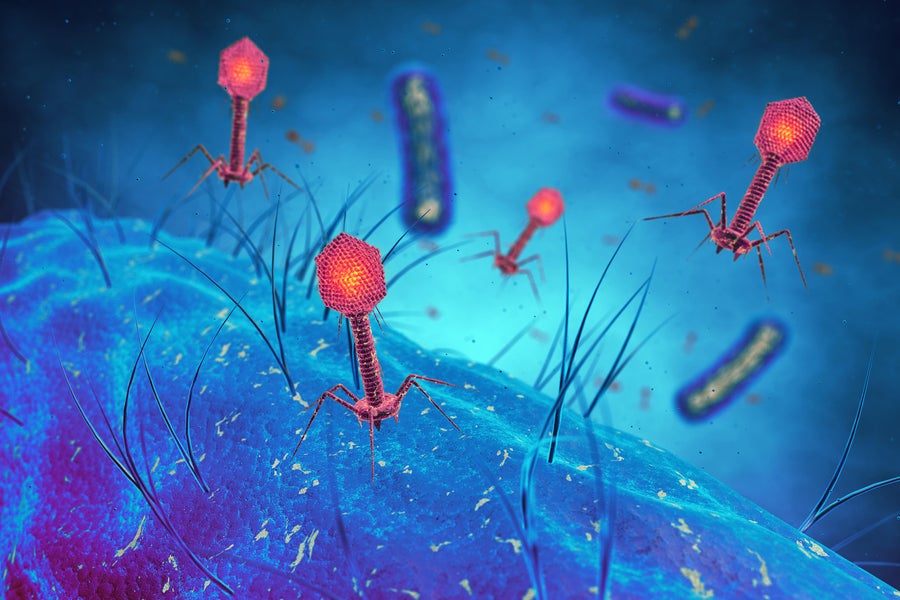
Bacteriophages infecting bacterial cells. Nobeastsofierce Science/Alamy Stock Photo
.
.
Click the link below for the complete article:
.
__________________________________________
 James' World 2
Leave a comment