
Click the link below the picture
.
December’s spate of drone sightings seen in New Jersey and spreading nationwide, sure looks familiar. As does its associated media frenzy—culminating in memes and conspiracy theories about so-called “mystery drones.” The episode bears an eerie resemblance to the UFO phenomenon, or the unidentified anomalous phenomena (UAP) one, that spiked in recent years and has led to significant congressional attention and legislation.
In a way, this is progress. The reason this outbreak looks so familiar is that such drone sightings would previously have been identified as UAP ones. It’s only after years of concerted efforts in education, and transparency by U.S. Department of Defense officials, that UAP sightings have rightfully evolved into common drone identification. That is not to say that the drone sightings are any less of a concern, but fortunately, we can address them without the contagion of the UFO community and the conspiracies associated with it.
Unfortunately, our response has been no less irrational.
A New Jersey state assemblyman has accused federal officials of “lying to us” about drones on CNN. The president-elect suggested we “shoot them down!!!” which is almost (but only almost, sadly) needless to say, a bad idea. So is wasting resources to investigate nonsensical notions of advanced technology related to Iran or, again, aliens. Calls for shooting objects down not only have obvious safety issues but fail to recall that Congress and the White House limited such strikes over U.S. territory after the incidents involving the Chinese high-altitude balloon and other balloons, based on concerns about civilian safety.
There are a couple of things we need to make clear about the drone sightings. First, many of the sightings remain mistaken interpretations of manned aircraft or satellites such as Starlink ones. The real drone sightings fall into two classes: those that are in restricted airspace, and those that are in legal airspace. Restricted airspace surrounds airports as well as national security areas such as Air Force and Navy bases. Most sightings reported fall within the latter category and have been assessed as having no immediate national security or flight safety risk, although the public finds them annoying.
One fact that many people tend to overlook, or at least don’t readily rationalize, is that these drones have lights on them. That lights are present on various flying objects including drones (also known as unmanned aerial vehicles, or UAVs) is a fact I often referred to in my last job, heading a Pentagon office investigating UAP sightings. Lights on a drone are for collision avoidance. They are a safety feature. Flying drones with lights ensures they can be seen; if they were meant to be unnoticed, the operators would turn off or disable the lights. In September 2023, the FAA changed the rules to allow drones to fly at night this way, and this is likely a contributing factor to the increase in sightings. The public and elected officials in Congress continue to believe lights in the sky are scary, however, particularly when they mistake crewed aircraft for drones.
Congressional officials and that unfortunate source of information, social media, continue to make unfounded claims of drone technologies far ahead of U.S. capabilities. The most recent example being the assertion that drones flew from an Iranian mother ship off the coast of the U.S. and demonstrated seven or eight hours of battery life. That fantastic assertion requires there to be evidence that the drones originated from an Iranian ship and were tracked continuously to the U.S. cities. There are no such tracks. The more rational explanation is that they originated near the place of the sighting, that is from domestic operators.
However, that doesn’t mean some drone operations aren’t ill-intentioned.
Several hypotheses (apart from mistaken identity) might explain these drones in legal airspace. They might be academic, professional or hobbyist domestic operators exploring a new technology. YouTube overflows with drone footage from amateur photographers all over the world. Flying in urban settings, in legal airspace, for photography, or maybe even some research such as high resolution thermal or pollution measurements is very plausible. Or they are commercial. Increased commercial activity is unavoidable as industry advances drone technology for delivery, remote sensing, and communications.
.
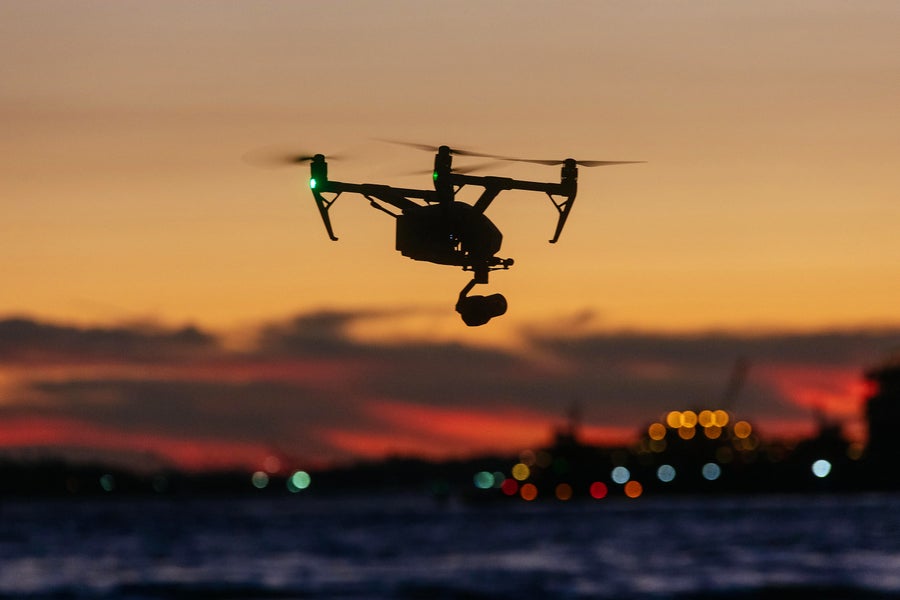 Valentyn Semenov/Alamy Stock Photo
.
.
Click the link below for the complete article:
.
__________________________________________
 James' World 2
Leave a comment