
Click the link below the picture
.
“Entry number 123!” The resonant words of Larry Mellinger, a senior attorney at the U.S. Department of the Interior, were followed by murmurs from the assembled crowd. An official from the U.S. Fish and Wildlife Service (FWS) moved slowly across the stage, holding up a seven-by-10-inch painting before each of five expert judges. Behind the judges, a screen displayed the same image writ large: a pair of bizarre yet beautiful ducks. With its bright orange bill, dense green feathers behind the nostril, and round patch of silvery-white feathers surrounding the eye, the Spectacled Eider is unlikely to be confused with any of the other four species that were eligible for this year’s contest. The colorful drake was pictured next to its brown-feathered mate in the early morning light, snowcapped Alaskan mountains rising in the far background.
This was the scene at the Bruce Museum in Greenwich, Conn., on September 20, when the judging of the 2024 Federal Duck Stamp Contest was poised to reach its climax. Over the previous two days, the auditorium had been packed with artists and spectators—a melting pot of flannel-clad veterans, aspiring young artists barely out of high school, curious onlookers, and even an adorable Seeing Eye puppy-in-training. The Duck Stamp Contest defies stereotypes: one is just as likely to spot a gray beard or a shock of bright blue hair in the audience. Additional thousands had been watching online, the live chat of the FWS YouTube channel bubbling with comments such as “I love the lighting on the neck here,” “eiders always look a little bit suspicious,” and even “Something about that Brant [goose] cheek is giving IDGAF brat energy.”
In the first round of judging, a field of 239 artworks was winnowed to 85. In the second round, 15 finalists were selected. Now everything was on the line. One of these paintings would appear on the 2025 Duck Stamp. The winner receives a sheet of 25 stamps signed by the Secretary of the Interior. It is a modest prize, to be sure, but victory conveys instant stature in the field of wildlife art. And print sales are so lucrative that the winning painting is often called “The Million-Dollar Duck.”
For the 338th time at the event, Mellinger intoned, “Please vote.” One by one, judges raised their numbered placard in an old-school process reminiscent of the judging for cold war–era Olympic figure skating. Four judges held up a 5, and one raised a 4. The audience gasped—the painting of the Spectacled Eiders had scored 24 out of a maximum of 25 possible points! Six more paintings were judged, but none surpassed that score.
For two days, the artists had been anonymous, but now it was revealed that the Spectacled Eiders were the work of Adam Grimm. This is Grimm’s third win, and his previous winning paintings of a Mottled Duck and a pair of Canvasbacks are currently on display in a gallery upstairs from where the competition was held, in an exhibition titled “Conservation Through the Arts: Celebrating the Federal Duck Stamp,” on view through February 9, 2025.
Duck Stamp Art on Display
As I stood in the back of the auditorium, listening to the thunderous applause fade away, I took a moment to reflect on my personal journey into the universe of the Duck Stamp. As recently as 2021, my familiarity with the Duck Stamp was limited to a vague awareness that its purchase is required to hunt waterfowl. Then I met Richie Prager. A conservationist and former Duck Stamp judge, he spent many years assembling a world-class collection of Duck Stamps before turning to a much more difficult task: tracking down the original art behind each stamp. Prager managed to acquire an astonishing 61 original artworks, along with many associated preliminary drawings and prints. Ultimately, he decided to donate them to the Bruce Museum, and Duck Stamp history became my life for the next three years. As science curator at the museum, I worked to organize an exhibition that showcases the art and artists behind the stamp.
.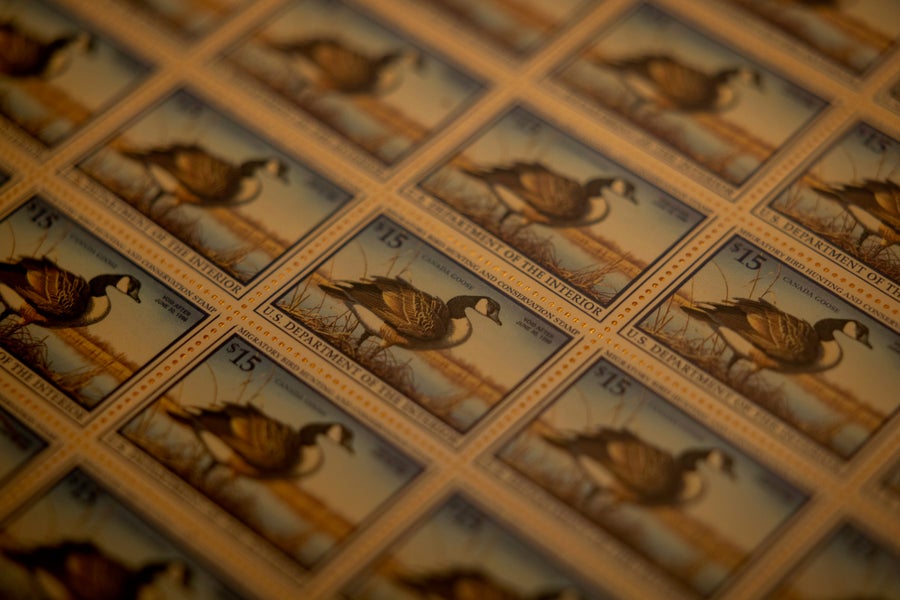
The 1997 Duck Stamp featured a painting of a Canada Goose by Robert Hautman. Patrick Sikes/The Bruce Museum

David Maass’s painting of a pair of Wood Ducks appeared on the 1974 Duck Stamp. David A. Maass
.
.
Click the link below for the complete article:
.
__________________________________________
 James' World 2
Leave a comment