
Click the link below the picture
.
When Lene was a child, she took comfort in a strange nighttime routine. While lying in bed just before she fell asleep, her bedroom would begin to warp, and her body would do so along with it. The far wall would stretch away from her head, her legs lengthening to meet it until she felt like she could touch the door with her toe if she tried. And all the while, it seemed as if she was floating in the corner, observing her distorted body.
“The first time I was very scared,” Lene says, recalling she was between seven and nine years old at the time. “I didn’t tell anyone, because if I told my mom, she would just say, ‘Eh, it’s nothing.’” She recalls that the episodes began happening every night, and eventually they became somewhat comforting. By adolescence, they had stopped, and she largely forgot about them.
Then, a few years ago, Lene, now age 59, learned that her experience had a name. She was at a hospital in Denmark where she works as a secretary in the neurology department. During a meeting where she was taking notes, a neurologist mentioned a patient with something called Alice in Wonderland syndrome. Intrigued, Lene did some research on Google, where she immediately recognized her own experience.
“All my life, since I was a child, I had this thing I couldn’t explain. And suddenly there was a word for it,” Lene says. During episodes of Alice in Wonderland syndrome, the world appears distorted, in many of the same ways that are described in Lewis Carroll’s famous novel, Alice’s Adventures in Wonderland. Bodies can morph out of shape; time can speed up or slow down; colors can fade or intensify. Often, these symptoms come with a sense of unreality called depersonalization or derealization. These distortions usually last between minutes and days and are known to be triggered by migraine, epilepsy, brain injury, drugs and infections.
While it’s rare to be diagnosed with the condition—fewer than 200 clinical cases have been officially reported since 1955, mainly in children, and it doesn’t appear in any mainstream diagnostic handbooks—Alice-like symptoms appear to be relatively common. One survey study published in 1999 found that some 30 percent of participants had experienced at least one kind of visual distortion in their life. And around 16 percent of migraine patients in a recent study also reported symptoms of Alice in Wonderland syndrome throughout their life. Some researchers have theorized that Carroll experienced these symptoms himself because he was known to experience migraines.
“The symptoms are as fantastical as the narrative of the book,” says Alberto Paniz-Mondolfi, an infectious disease physician at Mount Sinai in New York City, who has encountered the condition throughout his career. “When you don’t have answers, that is an enigma. And this is a condition that remains, in all of its aspects, largely unanswered.”
Still, researchers have begun to assemble many of the pieces of the Alice in Wonderland syndrome puzzle. The number of published studies on the condition has more than doubled since 2010, giving researchers important new insights into what causes these symptoms, says Jan Dirk Blom, a psychiatrist at Leiden University in the Netherlands and author of a 2020 book on the syndrome. And most recently, researchers have uncovered a potential answer to one of the syndrome’s biggest mysteries: What happens in the brain when people enter the rabbit hole?
The Looking Glass
We often think that our five senses allow us to observe the world as it truly exists—that “our brain is some sort of canvas or display for the reality” around us, says Maximilian Friedrich, a neurologist at University Hospital of Würzburg in Germany. “But it turns out that this is not the case. Perception is an active process.” The brain does not record reality through sensory input like a camera; it synthesizes, interprets, and reconstructs it.
.
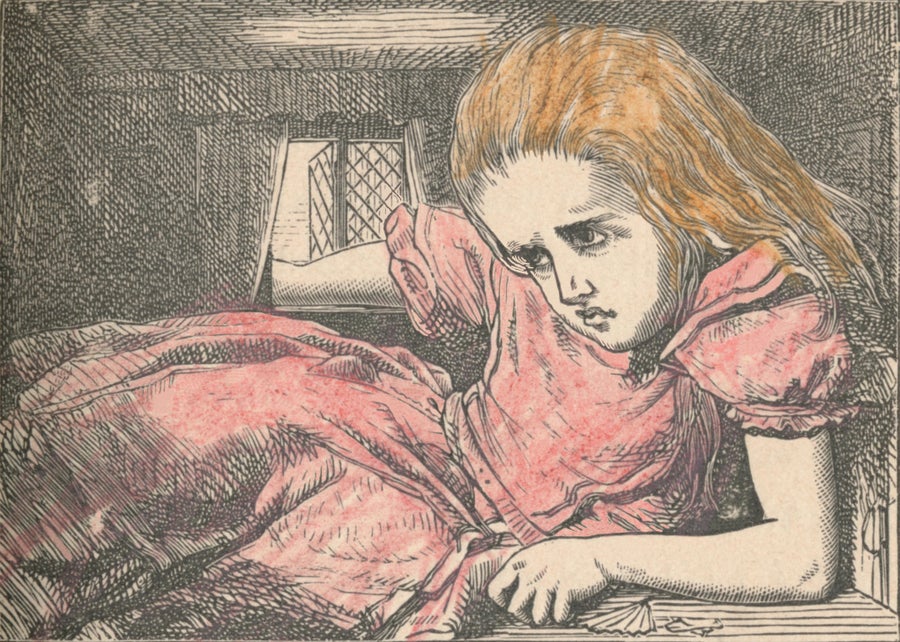
An illustration by John Tenniel depicts a scene in Alice’s Adventures in Wonderland. The Print Collector/Heritage Images/Alamy Stock Photo
.
.
Click the link below for the complete article:
.
__________________________________________
 James' World 2
Leave a comment