
Click the link below the picture
.
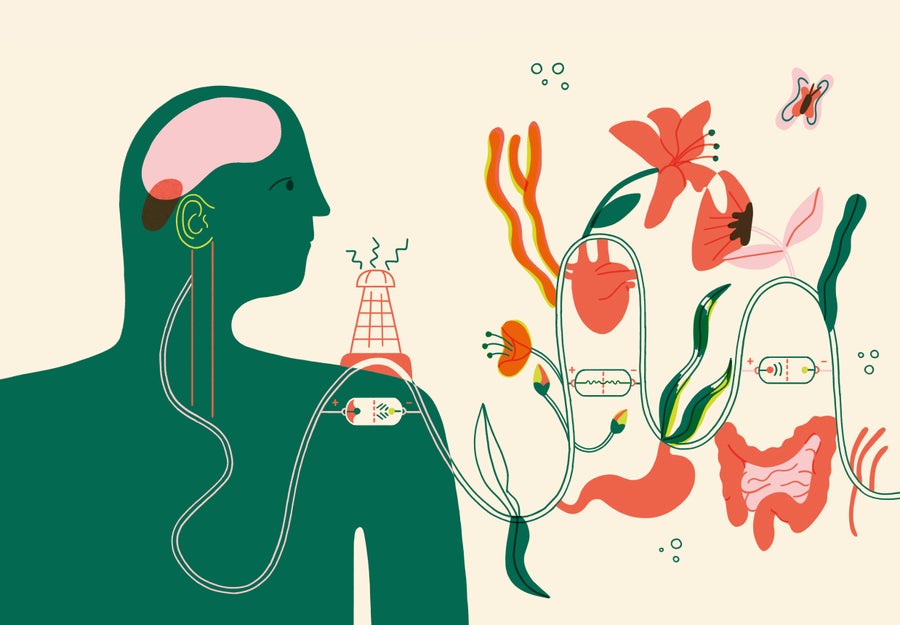
The vagus nerve is a vine of nerve fibers with roots in nearly every organ and shoots in the brain. It helps us detect a racing heart, rising blood pressure, stomachache, discomfort, an overzealous immune system and even alarm calls from microbes in our gut. When it senses trouble, the vagus helps to steady our heart, soothe our stomach, rein in our immune system and calm us down.
Wellness influencers claim we can ice, tone or zap the vagus nerve to fix almost anything—long COVID, headaches, poor memory, extra pounds, the blues. Much of that hype is unfounded. Still, some research on the vagus nerve is intriguing enough—and promising enough—to draw serious scientific attention.
Investigators have long known that activating the vagus with mild electrical pulses can treat some conditions. In 1997 the U.S. Food and Drug Administration approved a vagus nerve stimulation (VNS) device that can be surgically implanted under the collarbone and linked to a wire wrapped around the nerve. It is widely used to treat cases of epilepsy that do not respond to drugs. In 2005 the FDA certified a similar device for treatment-resistant depression, and the agency approved yet another one in 2021 to speed up recovery from stroke. Gadgets that stimulate the vagus nerve from outside the body, such as at the outer ear or neck, have been cleared in many countries, including the U.S., to treat obesity, pain, and migraines.
Signaling confidence in the potential of VNS, the National Institutes of Health Common Fund launched a $250-million initiative in 2015 with a second phase in 2022. The program, called SPARC (for Stimulating Peripheral Activity to Relieve Conditions), seeks to map the nerve’s individual fibers and circuits and to illuminate their functions. Scientists hope it will enable them to refine existing treatments and find new therapies for other conditions, ranging from inflammatory bowel disease to long COVID. Clinical trials are underway on so-called transcutaneous VNS (tVNS) devices, which are easier to use because they access the vagus from outside the skin, or cutaneous barrier. These tools potentially could be used to treat rheumatoid arthritis, migraine, lupus and chronic fatigue syndrome—and that’s just a partial list.
“A truly revolutionary idea can take 20 to 40 years before it’s thoroughly adopted,” says neurosurgeon Kevin J. Tracey of the Feinstein Institutes for Medical Research in Manhasset, N.Y., “at which point everyone says how we needed that all along.” The vagus vine’s power may be partly mythical, and the research on it is by no means conclusive or clear. But some scientists say it offers hope for millions suffering from complex, hard-to-treat conditions.
In 1664 English neuroanatomist Thomas Willis named the longest of the brain’s nerves the vagus, Latin for “wandering.” “We call it the vagus nerve, singular, but there are actually two, one on each side of your body,” Tracey says. Each side has up to 100,000 fibers, and each fiber contributes to a specific function: heart rate, breathing, immunity, gut contractions that help to digest food, even speech. About 80 percent of vagal nerve fibers are afferent, reporting to the brain about the state of the body; the rest are efferent, carrying instructions down from the brain. British physiologist Walter Holbrook Gaskell demonstrated in the late 19th century that afferent signals tend to excite, whereas efferent ones quiet.
The first person to zap the vagus with an electric current, using something like a tuning fork pressed against the neck, was American neurologist James Leonard Corning in the 1880s. He was trying to reduce blood flow to the brain to cure epilepsy, but his idea failed. A century later, however, neuroscientist Jacob Zabara of Temple University in Philadelphia found that directly applying an electrical signal to the nerve in a canine could disrupt irregular brain activity, thereby reducing seizures. In 1988 neurologist James Kiffin Penry and neurosurgeon William Bell became the first to implant a VNS device into a human to treat epilepsy.
When the vagus nerve brings news of dangerous inflammation in the body, the brain sends down signals to soothe it.
The VNS device currently used for epilepsy, which delivers a pulse every few minutes, is a direct descendant of Zabara’s invention. A pivotal study demonstrated that it cut the frequency of seizures by 45 percent on average after a year. It is believed to work mainly by stimulating the afferent fibers, the ones leading up to the brain.
.
 Noemi Fabra
.
.
Click the link below for the complete article:
.
__________________________________________
 James' World 2
Leave a comment