
Click the link below the picture
.
Right now, people who love looking at the wonders of the heavens have it better than ever. Every day brings some new jaw-dropping snapshot from at least one of the myriad observatories now operating on the ground or in space, each offering a new view of alien worlds, exploding stars, colliding galaxies or any number of other astrophysical phenomena. Most of these images are paeans to cosmic forces and inconceivable scales that carve stunning beauty from epic violence.
But not everything in our galaxy (or beyond) is the outcome of such ostentatious chaos. Some of the most visually captivating celestial objects are quiet, steady, even calm—and so dark that they not only emit no visible light but actually absorb it, creating a blackness so profound they seem to be a notch cut out in space.
These shadowy expanses have many sobriquets—dark nebulae, dust clouds, knots—but I prefer to call them Bok globules, a name they received in honor of Dutch-American astronomer Bart Bok, who studied them.
A Bok globule is a small, dense clump of cosmic dust; millions of them are scattered around our galaxy. They are cold and opaque to visible light, so much so that until quite recently the only way to see them was in silhouette against brighter background material. While not as splashy as their star-factory cousins, such as the Orion Nebula, Bok globules can still make stars, albeit in a more artisanal way: they make one or a few at a time that are largely hidden from our prying eyes in the dust’s abyssal depths.
Of all the dark globules we can see with our telescopes, my favorite beyond a doubt is Barnard 68, colloquially called B68. Located about 500 light-years from Earth, it’s a vaguely comma-shaped and coal-black cloud a mere half light-year wide, spanning some five trillion kilometers. We see it easily because it’s in the constellation Ophiuchus, with the star-packed center of our Milky Way galaxy as its backdrop. B68 appears to us as negative space, an absence of stars.
Why is it so dark? Although mostly made of hydrogen gas (like pretty much everything else in our galaxy), B68 also has an abundance of carbon. Some of this element is locked up in small molecules such as carbon monoxide, but much of the rest instead resides in long, complex molecules that make up what astronomers generically call dust. One distinguishing (or extinguishing) characteristic of dust is its capacity to block visible light.
And dust clouds can be dark indeed. In the case of B68, any star located on the other side from us will have its light diminished by a factor of 15 trillion. To put this in perspective, dimming the sun in our sky by this much would reduce it to a fourth-magnitude star difficult to spot in even mildly light-polluted skies. If you were on one side of B68 and the sun on the other, the sun’s light would be so attenuated across that half light-year that it would become invisible to the naked eye.
Such extreme darkness makes B68—and Bok globules more generally—subject to continual mistaken identity. Some years ago astronomers discovered the existence of huge volumes of space largely bereft of galaxies; these are called cosmic voids and can be many millions of light-years across. Alas, I’ve seen quite a few breathless videos and articles about them illustrated with an image of B68. It’s irritating to me as an astronomer to see this mistake because these are very different objects, but it’s also rather amusing because the actual voids being discussed are millions of times larger than our friendly nearby Bok globule.
.
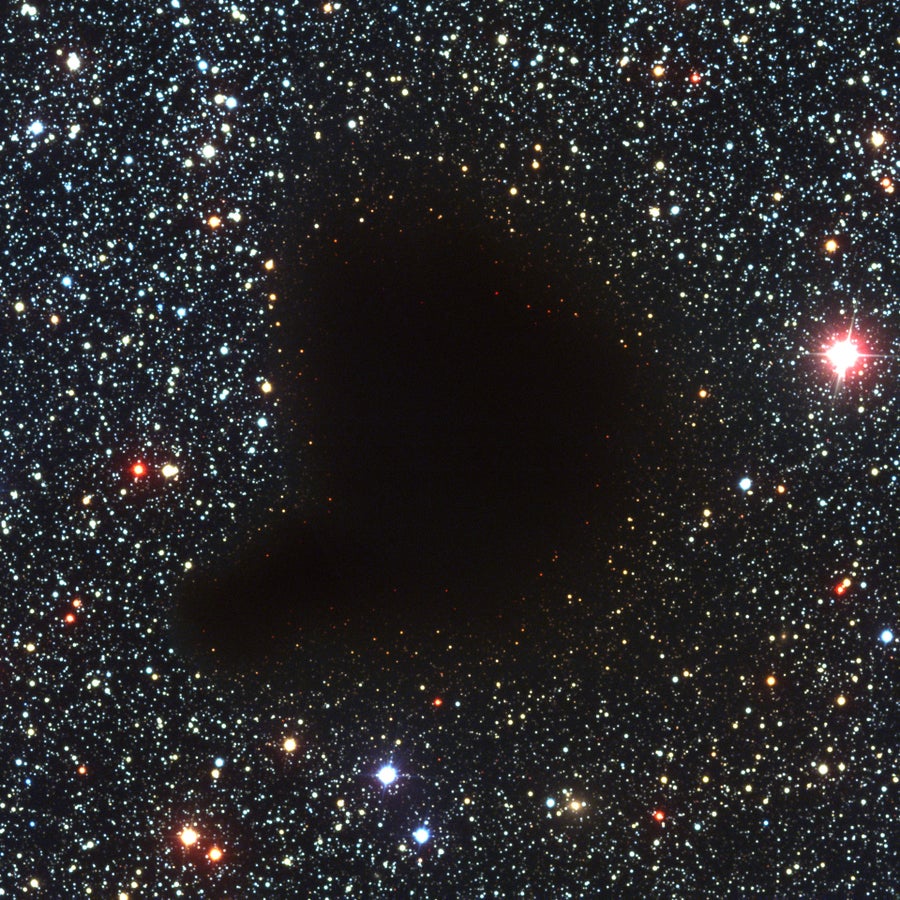
A view of Barnard 68 (B68), a dark and dusty nebula some 500 light-years from Earth. ESO
.
.
Click the link below for the complete article:
.
__________________________________________
 James' World 2
Leave a comment