
Click the link below the picture
.
Earth’s surface is a turbulent place. Mountains rise, continents merge and split, and earthquakes shake the ground. All of these processes result from plate tectonics, the movement of enormous chunks of Earth’s crust.
This movement may be why life exists here. Earth is the only known planet with plate tectonics and the only known planet with life. Most scientists think that’s not a coincidence. By dragging huge chunks of crust into the mantle, Earth’s middle layer, plate tectonics pulls carbon from the planet’s surface and atmosphere, stabilizing the climate. It also pushes life-fostering minerals and molecules toward the surface. All of those factors add up to a place where life thrives from ocean abysses to towering peaks.
But researchers don’t know why or when plate tectonics started, making it hard to determine how essential this process was to the evolution and diversification of life. Some think plate movement fired up as little as 700 million years ago, when simple multicellular life already existed. Others believe only single-celled organisms reigned when Earth’s plates first cracked apart.
In fact, as new methods allow scientists to look ever-deeper into the past, some are now arguing that plate tectonics emerged very soon after Earth’s formation — perhaps predating life itself. If this hypothesis is true, it may suggest that even the most primitive life evolved on an active planet — and that means plate tectonics could be an essential ingredient in the search for alien life.
“The only way we can reliably see a long-term history is on our own planet,” said Jesse Reimink, a geoscientist who studies early Earth history at The Pennsylvania State University. “We really need to understand the life cycle of a planetary body before we can do a lot with the exoplanet data.”
Destruction of evidence
Only Earth has jigsaw-like tectonic plates that crash together and pull apart like bumper cars. The other rocky planets in the solar system have a single, rigid shell of crust — a geological arrangement that scientists call “stagnant lid” or “single lid” tectonics.
In plate tectonics, pancake-like chunks of brittle crust and upper mantle ride on the hotter, more mobile mantle below. New crust forms at midocean ridges, where gaps between separating plates create space for magma from the mantle to rise. In a geologic balancing act, dense oceanic crust is destroyed at subduction zones, where one plate slides under another. The oldest known bit of oceanic crust, located in the Mediterranean, dates to just 340 million years ago, making it far too young to be useful for pinpointing when plate tectonics arose.
.
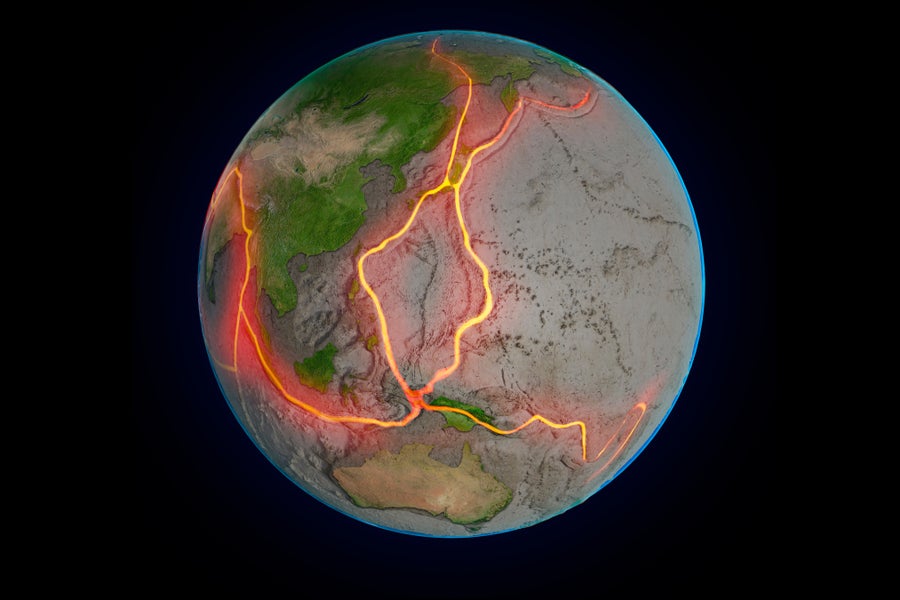
Plate tectonics may have played a larger role in the evolution of life on Earth than we previously thought. Andrzej Wojcicki/Science Photo Libary/Getty Images
.
.
Click the link below for the complete article:
.
__________________________________________
 James' World 2
Leave a comment