
Click the link below the picture
.
No part of our body is as perishable as the brain. Within minutes of losing its supply of blood and oxygen, our delicate neurological machinery begins to suffer irreversible damage. The brain is our most energy-greedy organ, and in the hours after death, its enzymes typically devour it from within. As cellular membranes rupture, the brain liquifies. Within days, microbes may consume the remnants in the stinky process of putrefaction. In a few years, the skull becomes just an empty cavity.
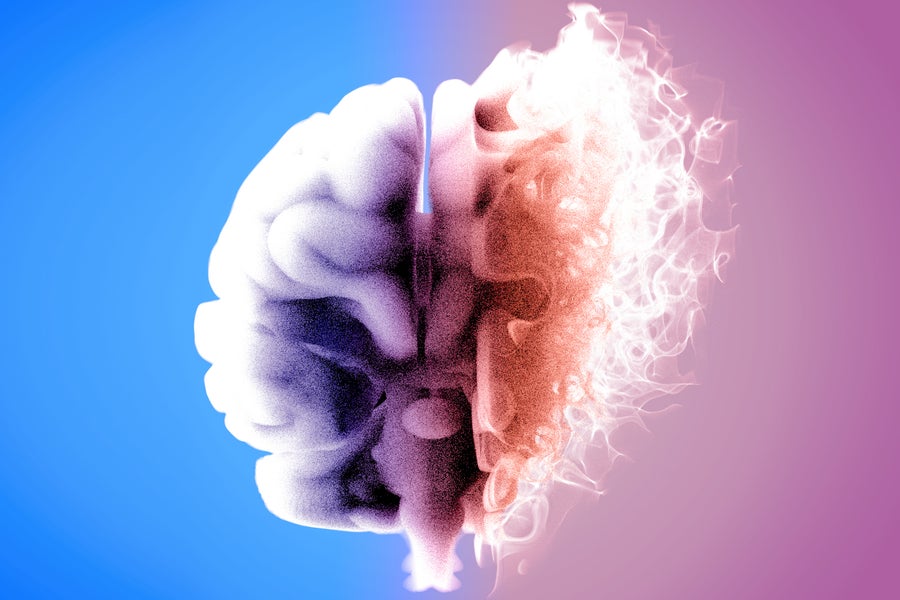
In some cases, however, brains outlast all other soft tissues and remain intact for hundreds or thousands of years. Archaeologists have been mystified to discover naturally preserved brains in ancient graveyards, tombs, mass graves, and even shipwrecks. Scientists at the University of Oxford published a study earlier this year that revealed that such brains are more common than previously recognized. By surveying centuries of scientific literature, researchers counted more than 4,400 cases of preserved brains that were up to 12,000 years old.
“The brain just decays super quickly, and it’s really weird that we find it preserved,” says Alexandra Morton-Hayward, a molecular scientist at Oxford and lead author of the new study. “My overarching question is: Why on Earth is this possible? Why is it happening in the brain and no other organ?”
Such unusual preservation involves the “misfolding” of proteins—the cellular building blocks—and bears intriguing similarities to the pathologies that cause some neurodegenerative conditions.
As every biology student learns, proteins are formed by chains of amino acids strung together like beads on a necklace. Every protein has a unique sequence of amino acids—there are 20 common types in the human body—that determines how it folds into its proper three-dimensional structure. But disturbances in the cellular environment can make folding go awry.
The misfolding and clumping of brain proteins is the underlying cause of dozens of neurodegenerative disorders, including Alzheimer’s disease, Parkinson’s disease, amyotrophic lateral sclerosis (ALS), and the cattle illness bovine spongiform encephalopathy (BSE), also called mad cow disease. Now scientists are discovering that some misfolded proteins also can form clumps after death—and persist for hundreds or thousands of years.
Only in recent years have scientists begun to seriously investigate these bizarre cases. A big breakthrough occurred in 2008 when archaeologists discovered the 2,500-year-old skull of a man who had been hanged, decapitated, and dumped into an irrigation channel in Heslington, England. All other soft tissue had long since vanished, but investigators were stunned to find that the skull still contained a shrunken brain.
A team of neuroscientists at University College London analyzed the ancient brain with a chemical analysis technique known as liquid chromatography–mass spectrometry and identified nearly 800 preserved proteins—the most ever discovered in an archaeological specimen. They concluded the ancient brain was preserved by the aggregation of proteins.
When Protein Folding Goes Wrong
In living organisms, protein folding is very context-dependent, and disturbances in the cellular environment can make it to go astray.
A classic example is egg white. Normally, it is a transparent liquid, but when conditions change—as when an egg is fried or boiled—its proteins unravel, become entangled, and form clumps. “That’s an aggregate,” says Ulrich Hartl, a leading researcher of protein-folding diseases at the Max Planck Institute of Biochemistry in Martinsried, Germany. “The same thing happens in your brain at a microscopic level.” Many diseases share a similar underlying mechanism: the protein abandons its healthy native state, unfurls, and becomes entangled in a jumbled mass with other misfolded proteins.
In diseases, the misfolded version becomes the protein’s most thermodynamically stable state, often making the aggregations irreversible. Hartl says he would not be surprised if a similar mechanism lay behind ancient brain preservation. “It’s fascinating that the brain can be preserved for such a long time after death,” he says. “The question of interest for me is: Does this reflect, in any way, what is going on during neurodegeneration?”
Enduring Brains
The discovery of the Heslington brain stimulated new research into brain preservation. The epicenter of this effort is the University of Oxford, and its lead investigator is Morton-Hayward, a former mortician turned molecular scientist. Now a Ph.D. candidate, she has gathered the world’s largest collection of ancient brains—more than 600 specimens up to 8,000 years old from locales such as the U.K., Belgium, Sweden, the U.S. and Peru—and she is analyzing how they were preserved. (The specimens were collected in accordance with Oxford’s research ethics guidelines.)
To understand why these brains haven’t decayed, Morton-Hayward has peered at ancient brain tissue with powerful microscopes. She has placed mouse brains in jars of water or sediment to measure how they decompose over time. She has employed mass spectrometry to identify the proteins and amino acids that persist in the ancient brains. She has identified more than 400 preserved proteins. (The most abundant of these is myelin basic protein, which helps form the insulating sheath on our neural wiring.) She has sliced up ancient brain tissues and taken the samples to the Diamond Light Source synchrotron (the U.K.’s national particle accelerator) to pummel them with electrons traveling at almost the speed of light to understand the metals, minerals and molecules involved in the preservation process.
Bodies can avoid decomposition via embalming, freezing, tanning, or dehydration, but Morton-Hayward focuses on cases where brains are the only soft tissues remaining. Typically, the preserved brains come from waterlogged, low-oxygen burial environments such as low-lying graveyards or, in the case of the Heslington brain, an irrigation ditch. Human brains are composed of about 80 percent water, and the rest is roughly divided between proteins and lipids (fatty, waxy or oily compounds that are insoluble in water). The Oxford researchers suspect that this unique chemistry makes neural tissue especially amenable to preservation.
.
Naeblys/Getty Images
.
.
Click the link below for the article:
.
__________________________________________
 James' World 2
Leave a comment