
Click the link below the picture
.
CLIMATEWIRE | Wildfire smoke can aggravate a variety of medical conditions, from asthma to heart disease.
Now, new research adds another worry to the mix. It can elevate the risk of dementia.
A study published Monday in the scientific journal JAMA Neurology, finds that long-term exposure to smoke concentrations is associated with a higher risk of dementia diagnosis over time. For every one microgram increase in wildfire pollution per cubic meter of air over the course of a three-year period, the odds of dementia diagnosis rise by about 18 percent, the study finds.
That’s compared with each person’s baseline risk of dementia diagnosis, which remains relatively low among the general population. Still, the increased risks are large enough to pose a public health concern.
The study focuses on a form of air pollution known as particulate matter — tiny, inhalable particles, with diameters of 2.5 micrometers or smaller. This kind of air pollution can originate from a variety of sources, including automobiles, industrial sources and fires.
Previous studies already have suggested that particulate matter can increase the risk of dementia, among other health problems. The new research zooms in specifically on particles produced by wildfire smoke, which can have different chemical and physical properties than particles produced by other sources.
The study examined medical records from more than 1 million people in Southern California from 2008 to 2019, all part of the Kaiser Permanente Southern California medical care consortium. It also analyzed air quality records from the same time period to estimate long-term pollution concentrations, including particles stemming directly from wildfire smoke.
The study found that wildfire smoke increases the risk of dementia significantly more than particulate matter from other sources. There are several reasons that could be the case, the researchers say.
Wildfire smoke particles tend to have higher concentrations of molecules known for toxic or inflammatory properties. And wildfire smoke tends to spike at certain times of the year, compared with other kinds of air pollution — intermittently exposing communities to extremely high pollution concentrations, which may have greater effects on their health.
The study also found that certain demographics are at higher risk than others, including people with lower incomes and people of color, including Black, Hispanic, and Asian communities.
Low-income communities often are at higher risk of exposure to air pollution, the researchers note. Lower quality housing in these communities may allow particulate matter to infiltrate homes more easily, and residents may have less access to air filtration systems.
Marginalized groups also may contend with more health challenges, in part because of systemic discrimination, compounding their risks of developing dementia later in life.
.
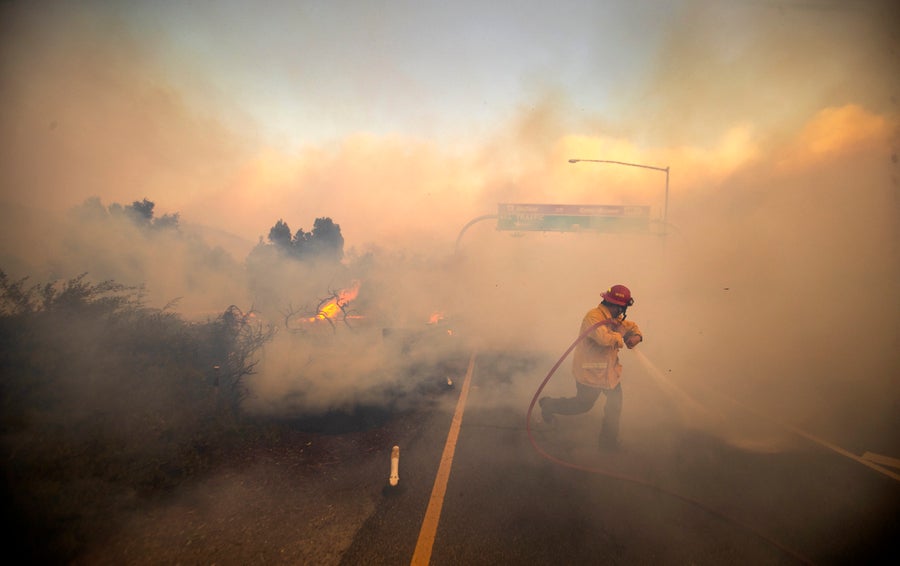
A firefighter is surrounded by heavy smoke as he battles the advancing Silverado Fire fueled by Santa Ana winds at the 241 toll road and Portola Parkway on October 26, 2020, in Irvine, California. Allen J. Schaben/Los Angeles Times via Getty Images
.
.
Click the link below for the article:
.
__________________________________________
 James' World 2
Leave a comment