
Click the link below the picture
.
Even before I could make out the silhouette of Platform Holly on the foggy horizon, I could see and smell oil. Ripples of iridescent liquid floated on the sea’s surface, reflecting the cloudy sky. But the oil wasn’t coming from a leak or some other failure of the rig. Milton Love, a biologist at the Marine Science Institute at the University of California, Santa Barbara, explained that it was “kind of bubbling up out of the seafloor.” Our boat, less than two miles from the central California coast, was sailing above a natural oil seep where the offshore energy boom first began.For thousands of years the Chumash, an Indigenous group native to the region, identified these oceanic seeps and their naturally occurring soft tar, known as malak, which washed up on the shore. Sixteenth-century European explorers noted oil off the coast of modern-day Santa Barbara, and in the 1870s the U.S. oil boom reached California. In the late 1890s the first offshore oil wells in the world were drilled from piers off of Summerland Beach; 60 years later the state’s first offshore oil platform was deployed to drill the Summerland Offshore Field.
Since then, 34 other oil platforms have been installed along the coast, and more than 12,000 have been installed around the world. These hulking pieces of infrastructure, however, have finite lifetimes. Eventually their oil-producing capacities tail off to the point where it is no longer economically viable to operate them—that, or there’s a spill. Today 13 of California’s 27 remaining offshore platforms are what’s known as shut-in, or no longer producing oil.
Platform Holly is among the dead platforms awaiting their afterlives. At the time of its installation in 1966, everyone knew a platform situated directly over a natural oil and gas seep was going to be a success. And for nearly five decades it was. Then, in 2015, a corroded pipeline near Refugio State Beach owned by Plains All American Pipeline cracked, spilling 142,800 gallons of crude oil into the Santa Barbara Channel. The spill killed sea lions, pelicans and perch, among other creatures; closed fisheries and beaches; and permanently severed Platform Holly from its market.
Venoco, the oil company that owned Holly at the time, was not responsible, but it was bankrupted by the event. Because Holly is positioned within three miles of the coast, it was transferred into the hands of the California State Lands Commission (SLC) in 2017. The SLC is now responsible for managing the process of decommissioning the platform and determining its fate.
Because Holly is already owned by the state, not an oil company, its transition could illuminate how to evaluate the fate of rigs worldwide based on science, not politics.
According to platform-decommissioning consultant John Bridges Smith, a former leasing specialist with the Bureau of Ocean Energy Management who counts ExxonMobil, ConocoPhillips and Chevron among his clients, Holly and the eight other platforms whose leases are terminated or expired will be decommissioned by the end of the decade. Based on the original contracts between the oil companies and the state and federal governments, which date to the 1960s, this means the structures will have to be fully removed. In December 2023 the Bureau of Safety and Environmental Enforcement recommended that all 23 California platforms standing in federal waters be fully removed.
Doing so will incur a great expense. That’s true everywhere but especially in California, where some of the platforms are in very deep water. According to one conservative estimate, completely removing all of California’s platforms would cost the responsible oil companies $1.5 billion. Smith says these companies would prefer to delay that process for as long as possible. Some environmental groups in California, meanwhile, are pushing to hold them to the speediest timeline.
Love, who has spent the past three decades studying the aquatic life that now calls southern California’s oil platforms home, would prefer a third alternative.
In the decades since they were installed, the steel support structures of California’s oil platforms have become vibrant ecosystems isolated from fishing pressures—de facto marine sanctuaries. Rather than being removed, aging fossil-fuel infrastructure and its serendipitously associated habitats can be salvaged in the ocean as state-managed artificial reefs. The entire topside—
the above-water portion of steel, offices and cranes—and shallow section of a rig are removed, but part of the submerged base may remain. A pathway for doing so already exists in the U.S. and has been successfully followed 573 times in the Gulf of Mexico. Similar examples can be found around the world, from Gabon to Australia. Because Holly is already owned by the state, not an oil company, its transition could illuminate how to evaluate the fate of rigs worldwide based on science, not politics.
When an oil platform is decommissioned, the process goes like this: First, in a phase known as plugging and abandoning, its oil wells are filled with concrete and sealed. Next, scientists conduct an environmental review and consider the various merits and risks of different removal strategies. The results determine a platform’s final resting place, which in most cases has been in a scrap metal yard. A platform’s support structure is called its jacket—hundreds of vertical feet of woven steel that is affixed to the bottom of the ocean. Most of the time engineers will use explosives to sever a platform jacket from the seafloor. The steel is then hauled to shore for disposal and recycling. Decommissioning is considered complete when a platform has been removed down to 15 feet below the mud line and the seafloor has been returned to preplatform conditions.
.
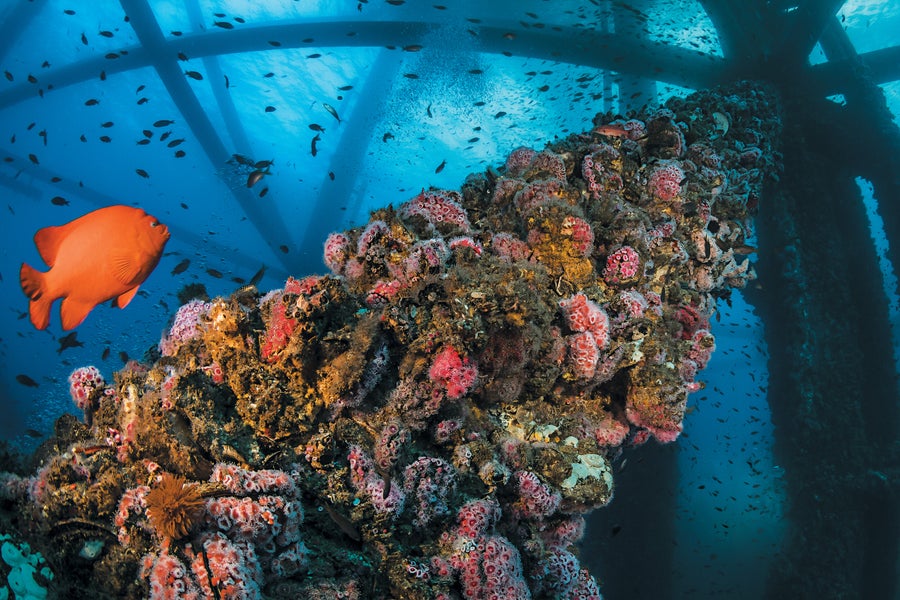
The steel “jackets” that support California’s offshore oil platforms are covered in millions of organisms and provide habitat for thousands of fish. Joe Platko
.
.
Click the link below for the article:
https://www.scientificamerican.com/article/should-offshore-oil-rigs-be-turned-into-artificial-reefs/
.
__________________________________________
 James' World 2
Leave a comment