
Click the link below the picture
.
Parenting a flock of Northern Bald Ibises is a demanding job. For the past six months, biologists Barbara Steininger and Helena Wehner have spent every day hand-feeding and raising dozens of these endangered chicks. They couldn’t pass their fostering duties off on anyone else during that time—the juvenile birds needed to imprint on them and them alone.
Steininger and Wehner then took to the skies to guide their young charges on the birds’ first migration. In mid-August, they climbed onboard a microlight aircraft in Rosegg, Austria, to start their approximately 2,800-kilometer journey, which ended on October 3 at a wintering site in Andalusia, Spain. There the two foster parents said their final goodbye to the birds that they helped raise.
“At the end, you have to release them in the wintering site and accept that they are now independent and don’t need you anymore,” says Johannes Fritz, who leads the team reintroducing Northern Bald Ibises to the wild in Europe and has been piloting the microlight aircraft on these guided migrations since 2004.
Bald Ibis Migration
Each fall, when the days grow shorter and the weather cooler, the ibises’ migratory instinct kicks in, priming them to seek out a warmer climate to spend the winter. Normally parents would guide their young on their first migration to show them the route. But the birds’ knowledge of their flight path has been largely lost. That’s because the species has been hunted nearly to extinction in its native habitat of North Africa, Central Europe, and the Middle East. In Europe, the species was in trouble as early as 1504, when the Archbishop of Salzburg decreed it illegal to shoot the birds. Despite this ban and other early conservation efforts, the Northern Bald Ibis was last seen in the wild in Europe in 1621, and only a small number have survived, mainly in Morocco.
Today, thanks to careful management and reintroduction efforts, some small sedentary (nonmigrating) populations live in the wild in Türkiye and Spain. But their inability to migrate might actually threaten their survival. Migratory birds evolved to reproduce in one climate and spend the winter in another. Splitting their time between two habitats can give them better access to food and higher reproductive success, explains Ana González-Prieto, an avian ecologist at the Canadian Wildlife Service, who is not involved in the reintroduction effort.
To have the best shot at success in the wild, Northern Bald Ibis populations need to migrate, Fritz says. So his team has taken on the responsibility of teaching young birds the route themselves. They were initially inspired by the 1996 movie Fly Away Home, in which a girl and her father help a flock of geese migrate using an ultralight aircraft. The movie was based on the work of the late Bill Lishman, a sculptor and filmmaker who used such an aircraft to teach captive-raised birds to migrate. Lishman co-founded Operation Migration, an organization that deployed bird-costumed scientists to guide endangered birds such as Whooping Cranes, once nearly extinct, on migratory routes across North America.
Fly Away Home with Bald Ibises
This method, called human-led migration, is both resource- and time-intensive, but for the Bald Ibises, it appears to be working. The process starts in the spring with foster parents who hand-rear chicks taken from captive-bred populations. Then, come late summer, the conservation team sets out on its route. A microlight aircraft powered by a propellor and kept aloft by a large yellow parachute takes off, soaring hundreds of meters above the ground. It flies at the speed of the birds, no faster than 50 kilometers per hour. The flying contraption seats two people—Fritz, who got his pilot’s license for this very purpose, and one of the two foster parents, who trade off on sky duty.
.
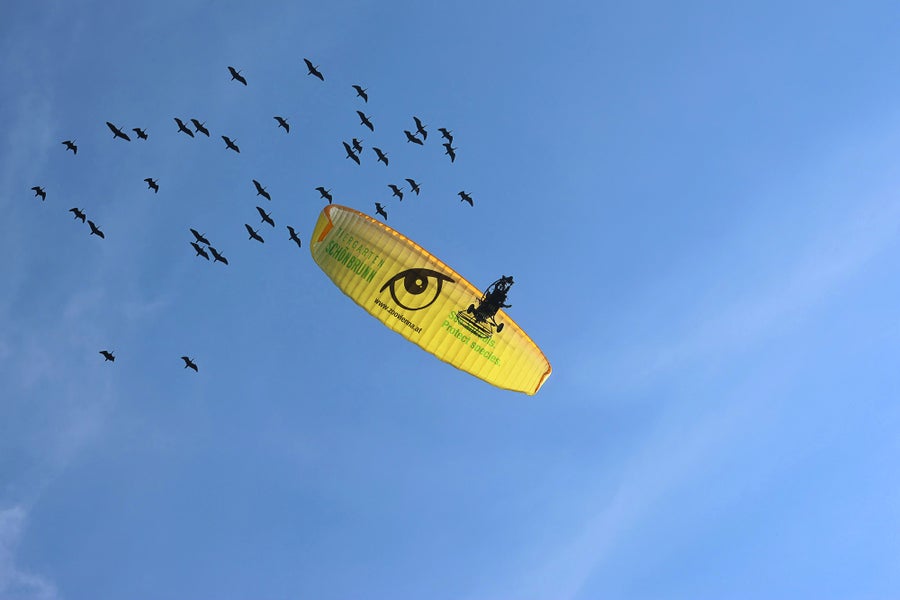
Johannes Fritz’s team guides Northern Bald Ibises on their migration to Spain. Waldrappteam Conservation and Research
.
.
Click the link below for the article:
.
__________________________________________
 James' World 2
Nov 10, 2024 @ 19:14:57
Neat information.
LikeLike
Nov 10, 2024 @ 22:55:47
Thanks for your comment!
LikeLiked by 1 person