
Click the link below the picture
.
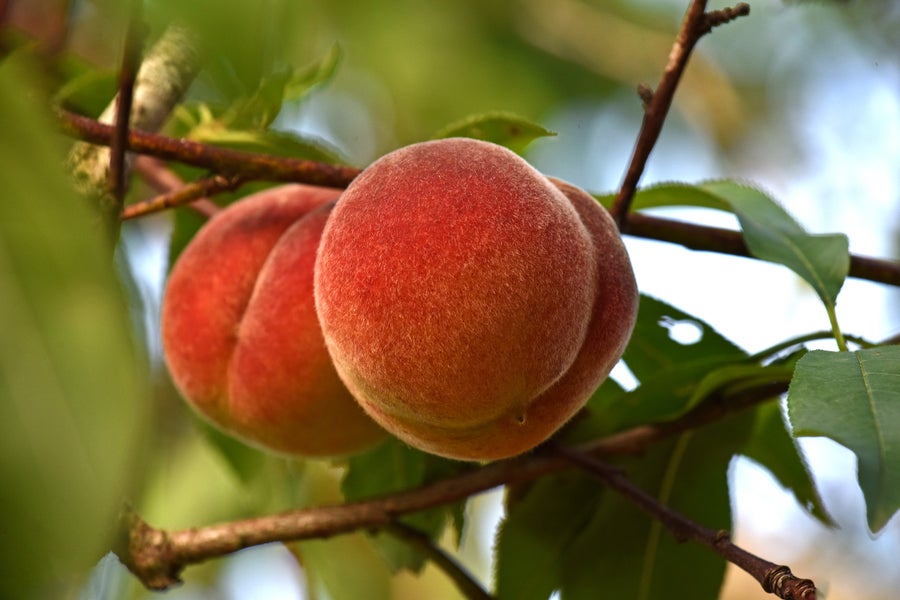
Behind every peach you bite into is the work of countless human generations.
The fuzzy, sweet stone fruit traces back to China, where it has been cultivated for more than 8,000 years. It wasn’t until the 1500s that Spanish colonists carried peaches into the Americas when they first explored the North American Southeast, where the fruit gained a foothold in what is now Georgia. Scientists have known that much about this symbol of summer. But how did peaches become so widespread in the U.S.? Research published in September in Nature Communications argues that after the fruit was introduced by Europeans, the peach spread across much of what is now the eastern U.S. with the help of Indigenous peoples.Today, Georgia is the Peach State,” says botanist RaeLynn Butler, secretary of culture and humanities at the Muscogee (Creek) Nation and a co-author of the new research. “That legacy stems from a long history.” Much of that history comes from the Muscogee (Creek) Nation and other Indigenous communities that lived in the area when peaches first arrived in the Americas.
“A lot of choices and agency by Indigenous people played a huge role,” says Jacob Holland-Lulewicz, an archaeologist at Pennsylvania State University and a co-author of the new research. They “were also responsible for structuring the ecology and the landscape to be an appropriate place for peaches to grow, and they tended to the peach plants.”
Holland-Lulewicz had long noted reports of peach pits found at archaeological sites across the southeastern U.S. And a few years ago he decided to compile these into a more detailed picture of how peaches spread—one that could shed light on the Indigenous histories that archaeology has typically ignored or suppressed. “I started to think about [the fruit] as a trade good,” he says. “Maybe we could use peaches to track, at a really high resolution, how Indigenous communities were interacting.”
The research team gathered evidence from more than two dozen archaeological sites and several early towns across the southeastern U.S. where one or more peaches had been discovered. Previous research at some of these sites had already provided a time frame for the presence of peaches. For the sites where that age had not yet been determined, the researchers used radiocarbon dating, either directly on peach pits or on other nearby materials to establish when peaches were likely present.
This work, however, showed only where peach pits had survived—not how people used the fruit or seeds. “We can’t see what people actually did with peaches and peach pits, so we’re making inferences based on the archaeological record,” says Kristen Gremillion, an archaeobotanist at the Ohio State University, who has researched peach history in the Americas but was not involved in the new research.
Perhaps the most surprising date the study authors determined comes from a site in inland Georgia, where Ancestral Muskogean people lived for a few decades beginning in the early to mid-1500s. The researchers suggest that the two peach pits found at this site may be related to Hernando de Soto’s early expedition inland in 1540, one of a series of journeys that bands of Spaniards made during their first century in the Americas.
Beyond this outlier, the peach pits didn’t appear to reach inland Georgia until decades later. The bulk of early peaches, dating to before 1600, come from coastal Florida and Georgia. The fruit then spread across a swath of northern Florida and southern Georgia between 1625 and 1640. By 1650, peaches had moved throughout the rest of Georgia and eastern Alabama, plus some sites in North Carolina and eastern Tennessee. The fruit had reached Arkansas by the 1670s, the researchers found, and prior archaeological records show peaches arriving in New York State before the beginning of the 18th century.
.
Minh Hoang Cong/500px/Getty Images
.
.
Click the link below for the article:
.
__________________________________________
 James' World 2
Nov 01, 2024 @ 15:24:28
Very nice
LikeLike
Nov 03, 2024 @ 11:02:33
Thank you sir, your comment is appreciated!
LikeLiked by 1 person