
Click the link below the picture
.
William Housty’s grandparents taught him the sacred duty of preparing for the salmon’s arrival each year. Before the first silver flashes appeared in the creek, his grandfather — following the wisdom passed down from his own elders — would clear woody debris, chase away seals, and maybe even fell a few trees to ensure a waterway was ready.
“They saw it as their responsibility to roll out a red carpet for the salmon because of their immense importance to us,” said Dúqva̓ísḷa William Housty, a member of the Heiltsuk Nation of British Columbia’s central coast.
This practice ensured that the salmon, the ecosystem, and their community could thrive together, said Housty, who is director of the Heiltsuk Integrated Resource Management Department (HIRMD), which manages resources in their traditional territory.
Welcoming the salmon is just one example of the way the Heiltsuk’s ancestral laws, or “Ǧvi̓ḷás — a set of principles centered on respect, responsibility, reciprocity, and stewardship for all sentient beings — have shaped their interaction with their environment.
Now, the Heiltsuk are using traditional knowledge in concert with modern scientific approaches to monitor wildlife, count salmon, and maintain the health of waterways in their traditional territory. From the outset, the HIRMD stewards decided that Ǧvi̓ḷás would guide how they managed their resources, as well as influence how they would work with other government offices, industry or other outside parties.
This has led the Heiltsuk to braid relatively new techniques, like DNA analysis, with ancient ones, like the use of traditional fish weirs, so they can study — but not impact — the ecosystem. Their work has revealed shifting bear habitats and climate change impacts on salmon. Both have led to increased protections for creatures that are critical to the ecosystem.
“We’re going back to the value system that our ancestors implemented for thousands of years,” Housty told Live Science. “In our eyes, it is for the betterment of everything.”
A Symbiotic Relationship
The Heiltsuk have lived in the diverse coastal rainforests, islands, and marine areas of their traditional territory for more than 14,000 years. Over that time, they passed on ancestral knowledge of how to care for and enhance the natural resources they depended on.
In the mid-1800s, however, the British colonial government asserted control over Indigenous lands. In the following decades, deforestation, overfishing and pollution led to a marked decline in the richness of life.
“Take a look out there — it’s beautiful,” Housty said, pointing to the shimmering ocean water west of Bella Bella, the central community of the Heiltsuk Nation. “But when you go underwater, it’s a different story — so many resources have been depleted to the extent that some of them have gone extinct.”
For instance, commercial fishing has led to drastic declines in Pacific herring (Clupea pallasii), eulachon (Thaleichthys pacificus), and Northern abalone (Haliotis kamtschatkana). Some salmon that once thrived in the rivers and streams around Bella Bella have disappeared.
Government officials, forest companies, and academia have their own agendas, said Q̓íx̌itasu Elroy White, an archaeologist who works part time for HIRMD. “It was often based on greed, commercial enterprise, and academic privilege and perspective,” White said.
This contradicted the Heiltsuk way of living in harmony with the environment, in which they take only what they need to ensure a sustainable supply of resources for future generations.
Protecting the bears
For many decades after colonization, federal and provincial agencies controlled fishing quotas, logging operations, and other resource management decisions that directly affected the Heiltsuk. However, that started to change in the 1990s, and a small team of Heiltsuk began doing field assessments on the health of the streams and salmon in the Koeye watershed, 34 miles (55 kilometers) southeast of Bella Bella. The team presented data to the Heiltsuk land use committee, which would use that information to craft conservation management plans. One key goal was to protect grizzly bear (Ursus arctos horribilis) habitat.
.
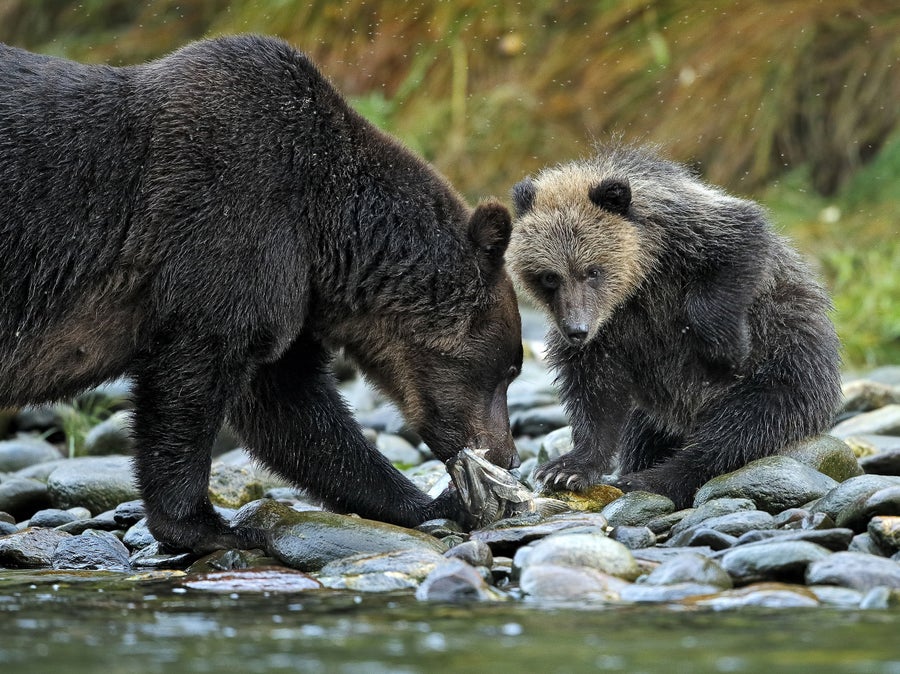
An adult female grizzly bear (Ursus arctos horribilis) and her cub feed on salmon in the Great Bear Rainforest, British Columbia, Canada. FLPA/Alamy Stock Photo
.
.
Click the link below for the article:
.
__________________________________________
 James' World 2
Leave a comment