
Click the link below the picture
.
Anosmia, or loss of a sense of smell, has become a more familiar term over the past few years, thanks to the prevalence of this condition during the COVID pandemic. Researchers have studied anosmia for centuries, and they have demonstrated that it reduces quality of life and can be associated with depression, early mortality, and other serious health outcomes. Now new research gets at another distinction between those who can smell and those who can’t.
Humans with so-called congenital anosmia, those who are born without a sense of smell, might breathe differently from people who have the ability. These breathing differences could account for the various negative health outcomes associated with anosmia, researchers argue in a study published on Tuesday in Nature Communications.
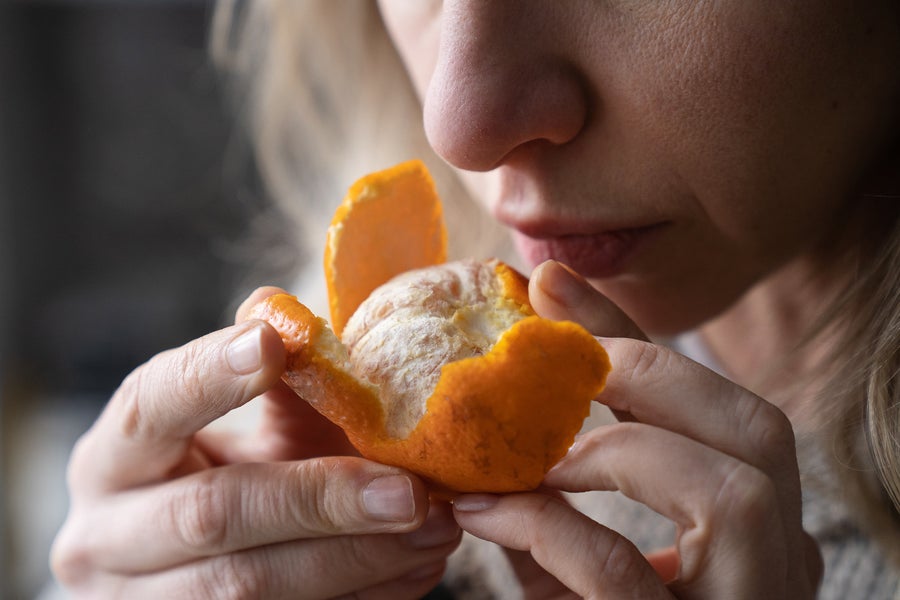
The idea that breathing and smell are connected is not totally new. Zara Patel, an otolaryngologist at Stanford University, who was not involved in the study, says that human beings constantly sample the environment for odors. We take and act on these cues to determine our behavior in response to our surroundings and to other people. Prior studies have also looked at the relationship between olfaction and breathing––but many of these have only been conducted in animals or in people who lost their smell because of viral infections or other more common causes of anosmia. (According to the new paper, congenital anosmia alone accounts for only about 4 percent of cases of the condition.)
“[This study] traces a mechanistic path that was not clear in humans before,” says Valentina Parma, assistant director of the Monell Chemical Senses Center, who was not involved in the research.
The new study, which was conducted by researchers in Israel, recruited 21 participants with isolated congenital anosmia and 31 people with a typical sense of smell. The researchers developed a wearable device that measured nasal airflow.
“The fact that we can monitor breath continuously for 24 hours is a game changer,” says Lior Gorodisky, a graduate student at the Weizmann Institute of Science in Rehovot, Israel, and the study’s first author. “After a few minutes, the participant is so used to this device that he behaves as usual, which is very different than sitting in a lab, fully aware of the situation.”
The researchers then analyzed the data from the 24-hour period to see how breathing differed between the two groups of people. While both groups breathe at the same overall rate, respiratory patterns were “profoundly altered” in the group with anosmia, the researchers wrote in the study. Those with a typical sense of smell had small inhalation peaks with every breath. These microsniffs did not occur when the participants spent time in a room without odor, suggesting their purpose was only for odor detection.
“What we think is: there is some sort of ongoing olfactory investigation of the world,” says Noam Sobel, a neurobiologist at the Weizmann Institute of Science and a co-author of the study. “You’re constantly asking, ‘Is there an odor here?’”
The study also found there was a subtle but statistically significant difference in the overall shapes of the participants’ breathing waveforms.
“This was significant to the extent that, based on these differences alone, we could tell who is anosmic and who isn’t [with] 83 percent accuracy,” Sobel says, “I don’t think there’s another example of that, of how you can tell who is or is not anosmic without using an odor for your test.”
Despite the study’s novelty, it has some limitations. For one, it has a small sample size. And it doesn’t track people across their lifetime, which is important because smell ability can change over time. The authors also acknowledge that for the control group, they only verbally asked about people sense of smell. Although all answered that their sense of smell was intact, it would have been more valid to administer a smell test.
Additionally, the study focuses on people with congenital anosmia, a population that is not as widely studied as those with other types of smell loss. But anosmia is more often acquired through a viral infection such as COVID, a traumatic brain injury, or neurodegenerative diseases such as Parkinson’s or Alzheimer’s.
The researchers “used a population of patients that have never experienced smell, and so it’d be nice to see if this holds up in patients who lost their sense of smell years ago,” says Eric Holbrook, director of the division of rhinology at Massachusetts Eye and Ear, who was not involved in the study.
.
 Dima Berlin/Getty Images
.
.
Click the link below for the article:
.
__________________________________________
 James' World 2
Leave a comment