
Click the link below the picture
.
In his first book, The Heat and the Fury: On the Frontlines of Climate Violence, political correspondent Peter Schwartzstein offers a vital and riveting account of how climate change is already pulling societies apart, feeding violence across the globe. Each chapter presents a nuanced case study: Across the Sahel, farmers and herders fight one another over access to limited water and fertile land. By the coast of Bangladesh, impoverished farmers turn to fishing to supplement inconsistent harvests and face capture by ransom-seeking pirates. Across Jordan, climate-related poverty turns villagers against their overwhelmed government and appears to boost recruitment in terrorist and non-state-armed groups. Schwartzstein draws on more than a decade of on-the-ground reporting to both distill and humanize these complex conflicts, be they local or national.
Scientific American spoke with him about the ways climate change ignites existing societal powder kegs, the mechanisms by which it distorts people’s decision-making and the risk climate-change-associated violence poses in wealthier, Western countries.
[An edited transcript of the interview follows.]
In many of the communities you have covered, you were one of few reporters raising questions about the links between climate change and conflict. How did you land on this angle? Do you think policymakers now see its significance?
I kind of fell into the field because the more straight political reporting space was saturated. But then the more I worked in the general climate and environment space, the more important I found it to be. I quickly realized I didn’t need to try hard to see the intense overlap—that I could tell the story of a country better by looking at it through the prism of water [access] and the environment than by a relatively superficial examination of the political scene. I mean, why, for example, does Iraq have water problems? For some of the same reasons, it has problems across the board: a legacy of conflict, meddling by countries near and far, incompetence, corruption, and an array of other troubles.
In 2015 I was quite literally laughed out of a room in the Iraqi Ministry of Interior when I broached with a senior Iraqi police general the possibility that climate troubles might be contributing to jihadi recruitment. To his mind and the mind of many of his contemporaries, this was just silly. But over the course of the past decade, there’s been an extraordinary sea change in attitudes, both in the wider Middle East and parts of Africa where I work, but also further afield. I’m still not convinced that many of these civilian and security officials that we see talking the talk on climate security see the linkages to the extent that their words might suggest, but there’s an understanding now of the need to at least pay lip service to the importance of climate change.
One difficulty seems to be that it’s hard to quantify the impact of climate change, and there are also so many different, overlapping factors that give rise to conflict. How do you disentangle these?
Yeah, I’d argue it’s almost impossible to effectively quantify the effect of climate change. What I try to do in this book and in my work is show that climate change is part of the equation, rather than put a dollar amount to the contribution. This gets at the heart, though, of why it’s taken so long for climate change’s destabilizing potential to be accepted to the extent that it has. It’s kind of a victim of its own nitty-grittiness.
Can you lead me through one of the examples in the book of how climate change might exacerbate or produce violence?
.
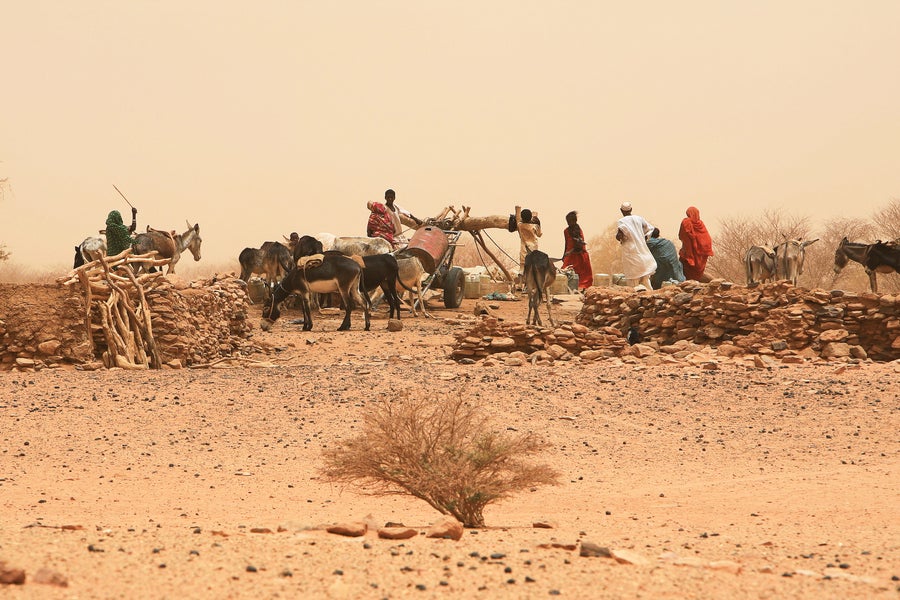
Sudanese people with their animals, fetching water from a deep well in front of the abandoned archeological site of Naqa, in northern Sudan. JordiStock/Getty Images
.
.
Click the link below for the article:
.
__________________________________________
 James' World 2
Leave a comment