
Click the link below the picture
.
Scholars have long contemplated the connection between language and thought—and to what degree the two are intertwined—by asking whether language is somehow an essential prerequisite for thinking.
British philosopher and mathematician Bertrand Russell answered the question with a flat yes, asserting that language’s very purpose is “to make possible thoughts which could not exist without it.” But even a cursory glance around the natural world suggests why Russell may be wrong: No words are needed for animals to perform all sorts of problem-solving challenges that demonstrate high-level cognition. Chimps can outplay humans in a strategy game, and New Caledonian Crows make their own tools that enable them to capture prey.
Still, humans perform cognitive tasks at a level of sophistication not seen in chimps—we can solve differential equations or compose majestic symphonies. Is language needed in some form for these species-specific achievements? Do we require words or syntax as scaffolding to construct the things we think about? Or do the brain’s cognitive regions devise fully baked thoughts that we then convey using words as a medium of communication?
Evelina Fedorenko, a neuroscientist who studies language at the McGovern Institute for Brain Research at the Massachusetts Institute of Technology, has spent many years trying to answer these questions. She remembers being a Harvard University undergraduate in the early 2000s, when the language-begets-thought hypothesis was still highly prominent in academia. She herself became a believer.
When Fedorenko began her research 15 years ago, a time when new brain-imaging techniques had become widely available, she wanted to evaluate this idea with the requisite rigor. She recently co-authored a perspective article in Nature that includes a summary of her findings over the ensuing years. It makes clear that the jury is no longer out, in Fedorenko’s view: language and thought are, in fact, distinct entities that the brain processes separately. The highest levels of cognition—from novel problem-solving to social reasoning—can proceed without an assist from words or linguistic structures.
Language works a little like telepathy in allowing us to communicate our thoughts to others and to pass to the next generation the knowledge and skills essential for our hypersocial species to flourish. But at the same time, a person with aphasia, who are sometimes unable to utter a single word, can still engage in an array of cognitive tasks fundamental to thought. Scientific American talked to Fedorenko about the language-thought divide and the prospects of artificial intelligence tools such as large language models for continuing to explore interactions between thinking and speaking.
[An edited transcript of the interview follows.]
How did you decide to ask the question of whether language and thought are separate entities?
Honestly, I had a very strong intuition that language is pretty critical to complex thought. In the early 2000s, I really was drawn to the hypothesis that maybe humans have some special machinery that is especially well suited for computing hierarchical structures.And language is a prime example of a system based on hierarchical structures: words combine into phrases and phrases combine into sentences.
And a lot of complex thought is based on hierarchical structures. So I thought, ‘Well, I’m going to go and find this brain region that processes hierarchical structures of language.’ There had been a few claims at the time that some parts of the left frontal cortex are that structure.
But a lot of the methods that people were using to examine overlap in the brain between language and other domains weren’t that great. And so I thought I would do it better. And then, as often happens in science, things just don’t work the way you imagine they might. I searched for evidence for such a brain region—and it doesn’t exist.
You find this very clear separation between brain regions that compute hierarchical structures in language and brain regions that help you do the same kind of thing in math or music. A lot of science starts out with some hypotheses that are often based on intuitions or on prior beliefs.
My original training was in the [tradition of linguist Noam Chomsky], where the dogma has always been that we use language for thinking: to think is why language evolved in our species. And so this is the expectation I had from that training. But you just learn, when you do science, that most of the time you’re wrong—and that’s great because we learn how things actually work in reality.
.
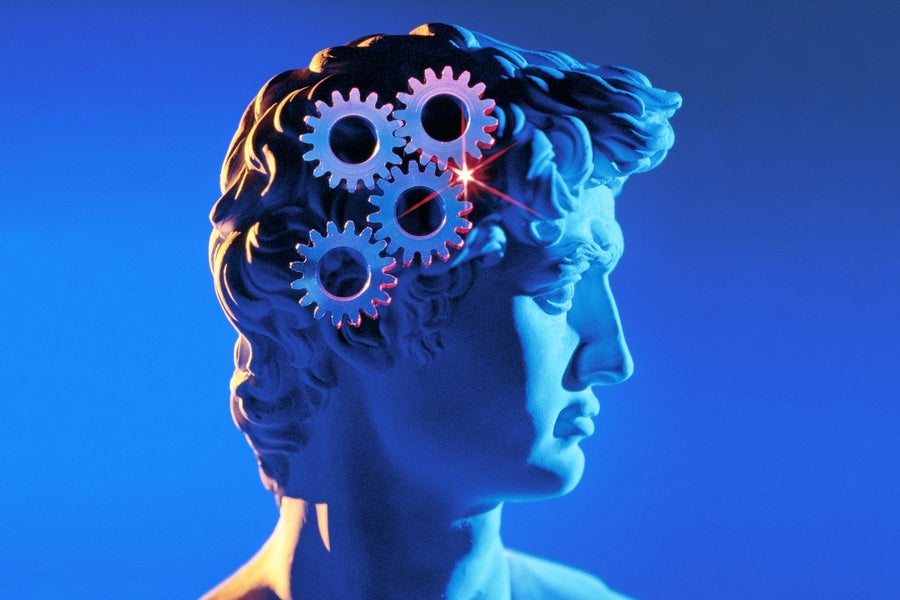 Comstock/Getty Images
.
.
Click the link below for the article:
.
__________________________________________
 James' World 2
Leave a comment