
Click the link below the picture
.
CLIMATEWIRE | In 1925, a small-town Ford dealer in Georgia named Albert Luce attached a wooden coach to the top of a Model T frame and sold it to the owner of a cement plant who wanted a way to transport his workers.
The idea evolved into a business, and nearly a century later the company — known as Blue Bird Corp. — has become one of the biggest school-bus builders in the country.
To stay ahead though, Blue Bird is transforming again. The company is shifting more of its business to electric school buses, even as it continues to crank out the same diesel-powered models that have ferried kids to school for generations.
The new approach for Blue Bird — and its competitors — is due in part to a windfall of money the Biden administration has steered to the industry.
The bipartisan infrastructure law provided $5 billion, overseen by the EPA, for school districts to buy the new buses. And the Inflation Reduction Act dedicated billions of dollars more in grants and tax incentives to pay for factories and battery plants.
But industry officials say the shift to electric was happening even before President Joe Biden took office. For that reason, they say they are optimistic the transition will continue no matter who wins the White House in November — even though there’s a clear difference between Vice President Kamala Harris and former President Donald Trump in their support for electrification.
“We’re going to be in this business for a long time,” said Albert Burleigh, vice president of alternative fuels for Blue Bird.
The company expects to double its e-bus sales from 546 in 2023 to 1,125 in 2025. And the new line could comprise as much as 40 percent of the company’s sales by 2027 — 4,000 to 5,000 buses out of 11,000 to 12,000 in total sales.
Blue Bird’s two largest competitors, Thomas Built Buses and IC Bus, are actively gearing up for the electric market too.
Thomas Built, owned by Daimler, has a factory in High Point, North Carolina, and sold its 1,000th electric bus earlier this year. The company added a third shift at its plant in 2022 to keep up with demand, and it set up a consulting team in 2023 to help customers plan for electric buses.
And IC Bus — which is based in Tulsa, Oklahoma, and is owned by Volkswagen’s Traton division — says school buses are a natural fit for electrification.
“With defined routes and a central depot, school buses are a perfect fit to transition to electric,” says the company on its website.
The e-bus industry got its start in the U.S. in 2014, when a handful of California school districts began buying electric buses to meet the state’s emissions requirements, according to a report from the World Resources Institute.
Another catalyst came in 2016 when Volkswagen agreed to pay $14.7 billion to settle allegations that it cheated on emissions reporting. The settlement allocated $2.7 billion for individual states to fund clean-air projects, and many of them focused on eliminating diesel-powered school buses.
.
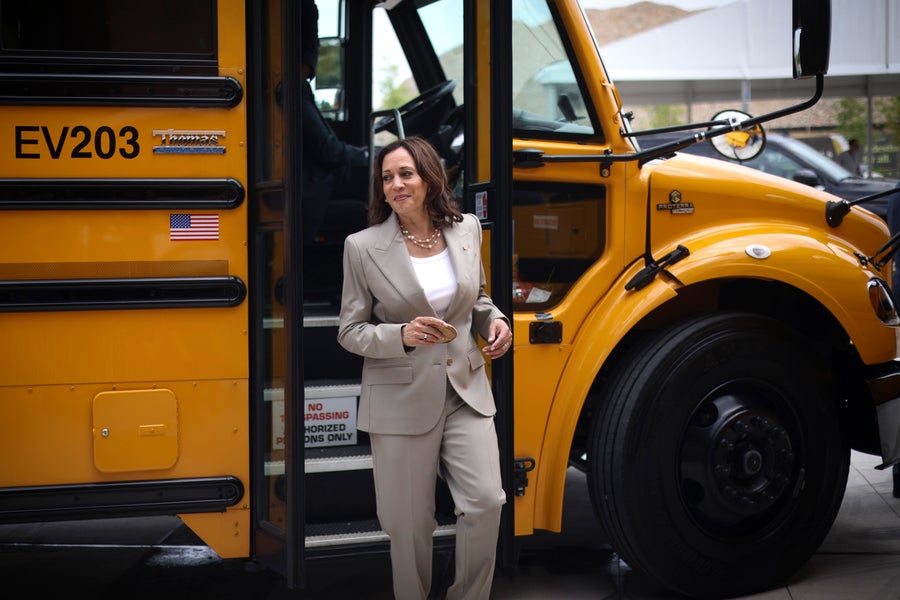
Vice President Kamala Harris walks off of an electric school bus during a tour at Meridian High School, in Falls Church, Virginia. Win McNamee/Getty Images
.
.
Click the link below for the article:
.
__________________________________________
 James' World 2
Oct 13, 2024 @ 19:02:27
Nice information
LikeLike