
Click the link below the picture
.
This article is part of a series on what the 2024 presidential election means for science, health, and the environment. Editors with expertise on each topic delved into the candidates’ records and policies and the evidence behind them.
The U.S. is home to more guns than people. The toll of this abundance of firearms is staggering: Guns killed more than 48,000 people in the U.S. in 2022, the equivalent of one person every 11 minutes. More than half of those deaths were suicides, and guns are the overall leading cause of death in children aged one to 17. Mass shootings—600-some per year in recent years, although definitions vary—have stoked fear and anger, reshaping the American school experience. Yet mass shootings make up only a tiny fraction of firearm fatalities. And about a third of Americans say they own a gun, even as six in 10 say they favor stricter gun laws.
The rage, despair, carelessness, and greed behind the deaths may be universal, but such numbers are unique to the U.S. Here “our interpersonal conflicts are much more likely to be lethal because we’re more likely to be armed with guns,” says Daniel Webster, a gun violence researcher at Johns Hopkins University.
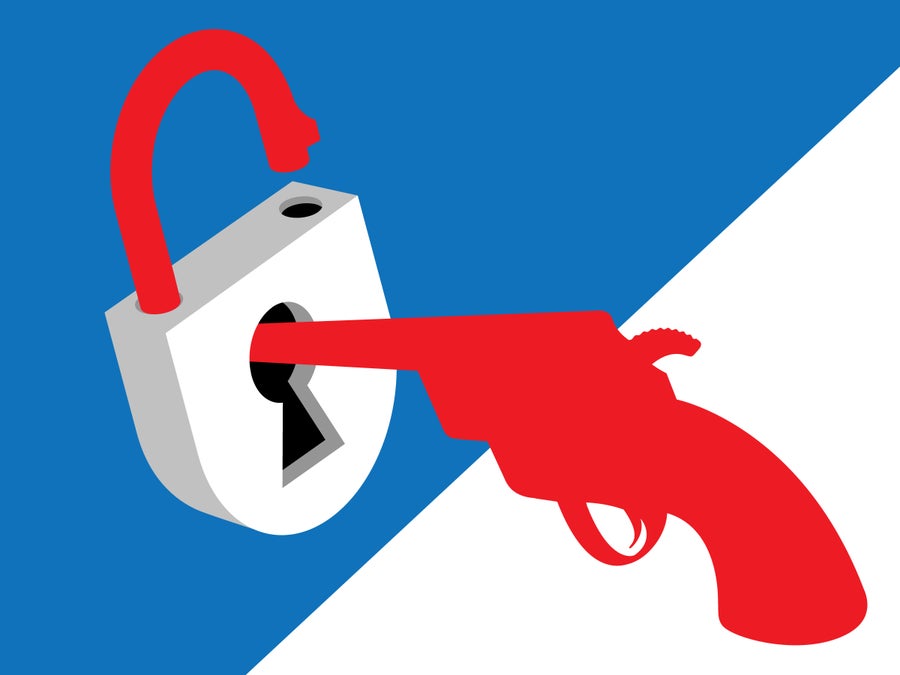
But there’s nothing inevitable about the prevalence of gun deaths in the U.S. It’s a reality that policies have created and that policies could change, if the political will existed. Evidence suggests that if Vice President Kamala Harris were to become the next U.S. president, she would move toward policies that would reduce gun violence—and that if former president Donald Trump were reelected, he would support laxer policies that could permit gun violence to worsen.
Compared with other common health issues in the U.S., data about gun violence are limited; data about nonfatal gun injuries are almost nonexistent. These gaps, combined with the usual scientific difficulties of distinguishing between causation and correlation, mean researchers lack much of the detailed information they need to analyze the effects of different gun-related policies. That said, the existing research does show that more guns do not keep people safer.
Here’s a rundown of what we can expect from each presidential candidate when it comes to gun policy:
Harris on Gun Policy
Harris has a long history of working with gun policy: She did so when she held a string of district attorney offices in the 1990s and 2000s and when she became California’s attorney general in the 2010s. Throughout those periods, she encouraged the development of stricter restrictions on gun ownership, as well as stronger enforcement of existing regulations. Later, as a U.S. senator, Harris worked on legislation to mandate universal background checks and to better regulate gun dealer licensing. She has in the past also called for both a ban on and a mandatory buyback of assault weapons, although Webster says studies suggest that assault weapon bans can be evaded too easily to impact violence rates.
In 2022, during the Biden-Harris administration, Congress passed the first sweeping gun legislation in nearly three decades. This included important funding mechanisms, as well as a few policy changes, such as requiring stronger background checks on gun buyers under 21 years old, requiring more gun sellers to conduct background checks, and broadening a measure meant to keep guns away from domestic violence offenders. The latter now include those who have abused dating partners, as well as spouses and close family members.
The single most effective policy to reduce gun deaths, according to Webster’s research, is an independent licensing process for gun ownership—not merely a background check managed by gun dealers themselves—that includes vetting the fingerprints and other information an applicant provides. Webster also finds positive results from regulations that take guns away from domestic violence offenders.
President Joe Biden created a White House Office of Gun Violence Prevention, which Harris oversees and which works on policies at both the state and local levels. “This is the first office of gun violence prevention that was initiated in the White House and overseen by a vice president,” says Joseph Richardson, Jr., a medical anthropologist at the University of Maryland. “I don’t think most Americans are even aware that she runs that office.”
.
 Thomas Fuchs
.
.
Click the link below for the article:
https://www.scientificamerican.com/article/how-a-harris-or-trump-presidency-could-affect-gun-policy/
.
__________________________________________
 James' World 2
Leave a comment