
Click the link below the picture
.
On some days, worries can cloud the typically upbeat mood at the Synval Santos Day Center, a modest care facility for the elderly with Alzheimer’s disease, in Volta Redonda, the old steel town 60 miles west of Rio de Janeiro. But Danielle Freire knows just what to do.
Freire, a psychologist, and the center’s coordinator, takes the anguished “patron” (no “patients” here, please!) by the arm and coaxes her (8 of 10 clients are female) to the faux “bus stop” in an arbored patio. There, they sit, chat, and reminisce about childhood and the old days, until the panic subsides, as they wait for a bus that never comes.
Years of trial and error have taught Freire’s team of 22 caretakers at Synval Santos how to manage sundown syndrome—a pique of late afternoon distress or the sudden urge to flee that is common to Alzheimer’s patients. Nimble intervention, one-on-one attention, patience, and a gentle sleight of hand is the routine for the facility’s 75 elderly patrons, who have moderate stage Alzheimer’s. (At the facility, which is part of the Davos Alzheimer’s Collaborative’s Healthcare System Preparedness Program, patients come for the day and go home in the evenings.)
“If you show concern, stay calm, and never argue,” Freire told me on a recent visit to the Center, “the stress passes, and even those anxious to flee soon forget their troubles.”
Brazil is a country the size of a continent, with staggering inequalities, where the wealthy enjoy world-class private health services and the poor languish at understaffed public hospitals. Synval Santos Day Center, however, is a rare exception in Latin America: a publicly financed and managed social service that works.
The institution’s decade-long record of caring for those with Alzheimer’s is already a beacon for Brazil and elsewhere. Its success makes it a magnet for people from surrounding towns and even out of state.
Volta Redonda, however, is atypical. It is one of just 106 towns among Brazil’s 5,568 municipalities to provide no-fee services—workshops, exercise, and cognitive calisthenics—for the elderly. The city boasts Brazil’s first and perhaps its only public center dedicated to Alzheimer’s. It’s much the same across Latin America, where the number of people with dementia is expected to soar from 7.8 million in 2013 to more than 27 million by 2050.
Many poor nations have islands of excellence in medicine and clinical care, but only for the well-off. Just 25 percent of Brazilians have private health insurance and access to top-tier treatment. In theory, Brazil’s Universal Health System (SUS, in Portuguese) tends to the other three-quarters through a nationwide network of free neighborhood clinics and hospitals. The system proved vital during the pandemic, treating COVID emergencies and administrating vaccines to millions, even as the central government downplayed the contagion and dismissed the advice of public-health experts.
But SUS is plagued by chronic underfunding, red tape, and patchy services that vary according to the agendas of local officials and national political class.
.
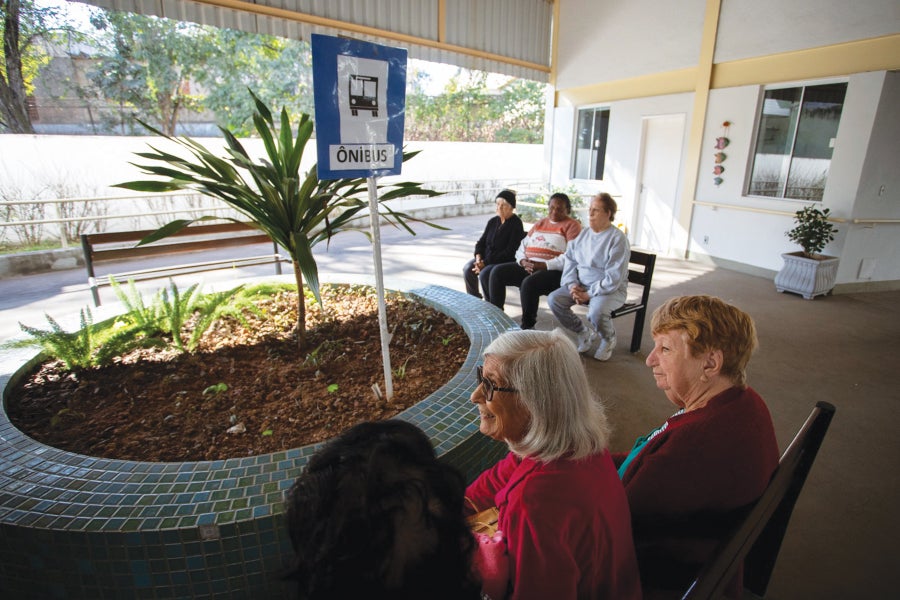
Patrons of the Synval Santos Day Center waiting at the “bus stop.” Image courtesy of Synval Santos Day Center
.
.
Click the link below for the article:
.
__________________________________________
 James' World 2
Leave a comment