
Click the link below the picture
.
Last year, when doctors told a patient that the headaches he was experiencing were due to a highly invasive brain tumor called a glioblastoma that could only be removed during a complex surgery, he had one very specific request.
He wanted the people who would be slicing the cancerous tissue out of his brain (from an area just to the left of the crown of his head) to make sure “to preserve a relevant aspect of his identity—his ability to play chess,” a paper in the journal Cortex reported this month.
The man, a then-45-year-old computer programmer, was identified only as “AB.” He had been playing the game as a hobby for 25 years and had achieved an Elo rating of 1,950, which is just one level below expert in the chess world.
AB made his request to conserve his chess skills to one of his surgeons, Andreu Gabarrós, head of neurosurgery at Bellvitge University Hospital in Spain, which is affiliated with the University of Barcelona. Gabarrós has a reputation for going out of his way for his patients, a commitment that sometimes carries over into his after-work activities. As leader of a band called Dorigen, he has recorded an album with 10 tracks—one choral number and nine solo songs. Each of the latter was composed for a different patient from whom he had removed a brain tumor while trying to protect areas needed to sing or play an instrument.
Upon hearing AB’s request, Gabarrós contacted his neuroscientist colleagues at the university in early March 2023. He asked if they could come up with a plan to map AB’s brain before and during the procedure, which would help his surgical team spare the brain tissue AB needed to return to his passion after recovery.
Two researchers at the university, part of a group led by cognitive neuroscientist Antoni Rodríguez-Fornells, began a mad dash in the ensuing weeks to develop a chess-preserving surgical protocol that Gabarrós’s team could use for the March 27 procedure. “We had a small amount of time to prepare everything,” Rodríguez-Fornells says.
The team combed the existing scientific literature on the topic and scanned AB’s brain using functional magnetic resonance imaging (fMRI) to isolate the regions linked to his own individual chess performance. “I started checking what was in the literature to find how can we divide chess into cognitive processes that are more easy to evaluate during the surgery,” says Victor Cepero-Escribano, one of the researchers.
The most critical phase of AB’s chess brain preservation—and the one that turned out to be the most insightful—would have to wait until the surgery itself began. Surgeons performed a craniotomy, removing a piece of skull to expose a portion of AB’s left superior parietal lobe while he was awake. Next, they touched a live electrode to different spots on the surface of his cerebral cortex, asking him to answer questions and complete tasks in order to determine whether his cognitive abilities remained intact at the targeted spot, where the current shuts down or triggers a particular action.
.
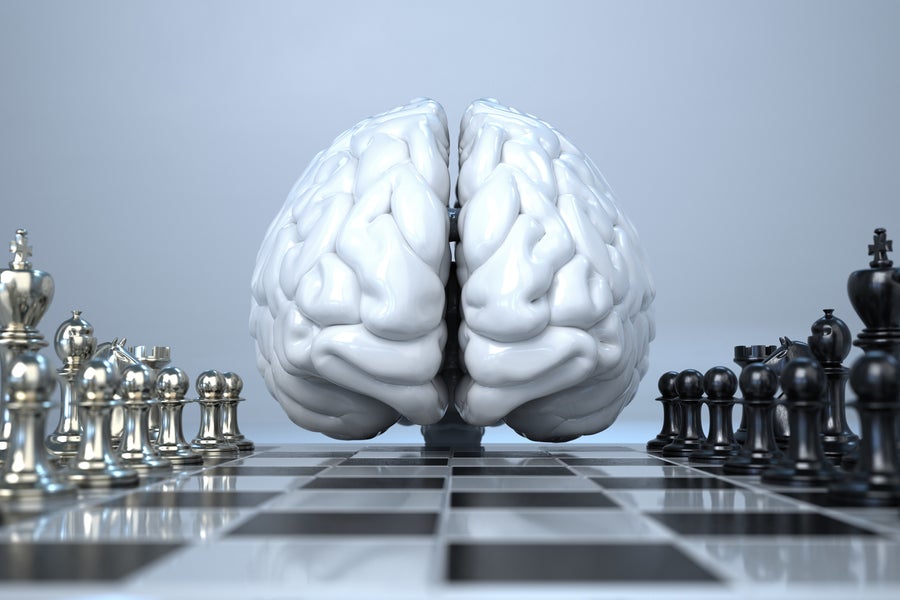 Style-Photography/Getty Images
.
.
Click the link below for the article:
.
__________________________________________
 James' World 2
Leave a comment