
Click the link below the picture
.
Tremendous advancements in science, public health, and material standards of living in recent decades means that people are living longer than ever before. In 1950, when the world’s population was 2.5 billion, life expectancy at birth was 46.5 years. In 2022, those figures rose to 8 billion and 71.2 years, respectively. By 2050, global life expectancy is projected to rise to 77.3 years.
This good news, however, presents a challenge: keeping many more older people healthy than ever before. By 2050, the number of people aged 65 and above is expected to reach 1.6 billion, up from 761 million in 2021, according to the U.N.’s World Social Report 2023.
Alzheimer’s disease is one of the gravest threats to this growing population: as more and more people live longer and longer, the total number of people with Alzheimer’s disease worldwide is expected to increase by more than 150 percent in the next 30 years. These people have progressively greater challenges in carrying out their day-to-day activities, are more likely to become injured from falls, and face major challenges managing otherwise straightforward medical problems. Many people with Alzheimer’s disease suffer from hallucinations, confusion, and depression. It is also an ultimately fatal disease.
Alzheimer’s disease can cause horrible suffering among patients and their caregivers. This suffering is part of the large burden Alzheimer’s imposes on people and their families, public-health systems, and nations. The economic cost of this burden is difficult to assess. It involves not only easily quantifiable effects such as treatment and long-term care costs and loss of work productivity and lifespan, but also myriad others that are not easy to measure, such as its effects on the mental health and livelihoods of caregivers and other indirect medical costs.
Quantifying the broad economic cost of Alzheimer’s disease is important, not least because it is needed to assess the soundness of the expense to bring tests and, eventually, treatments to so many people through health systems. To this end, we have undertaken a comprehensive analysis, drawing on data from the Institute for Health Metrics and Evaluation (IHME), a leading research organization specializing in analyzing the global burden of diseases, as well as from other organizations and prior studies. We used a methodological approach that estimates the economic burden of Alzheimer’s disease based on people’s willingness to pay to avoid the risk of death. We also developed a macroeconomic model of the productive capacity of a country’s economy that allows for a reduction in labor and capital formation resulting from the disease burden. These methods take into account a wide array of direct and indirect costs of Alzheimer’s disease for individual patients, caregivers, and the aggregate economy.
Based on our willingness-to-pay approach, we estimate that the global economic burden of the disease in 2019 was roughly $2 trillion. By 2050, that burden will rise sharply to about $10 trillion and perhaps as high as $13.5 trillion. For comparison, world GDP is projected to be $228 trillion (inflation adjusted) in 2050.
.
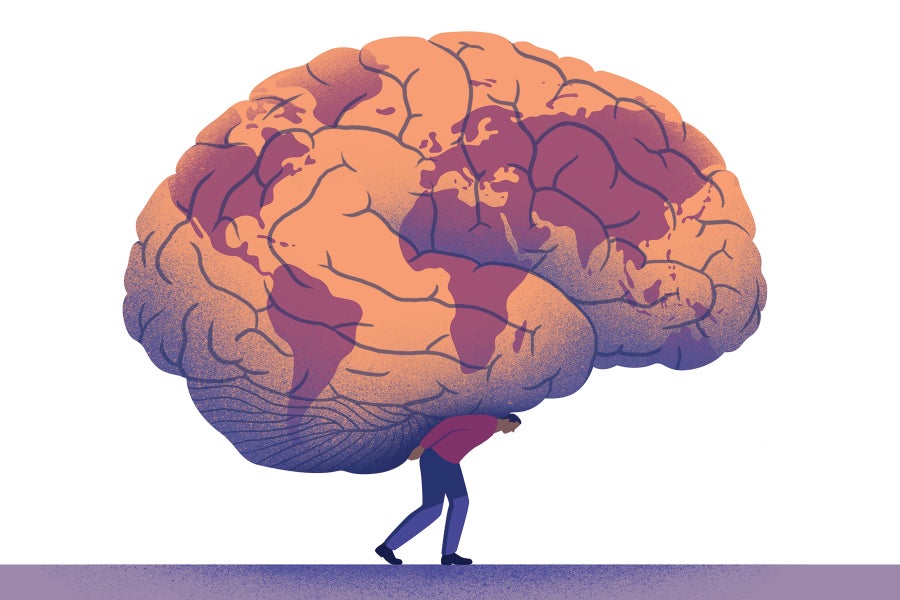
Dementia poses a global economic challenge, affecting rich, middle-income and poor nations. Davide Bonazzi
.
.
Click the link below for the article:
.
__________________________________________
 James' World 2
Leave a comment