
Click the link below the picture
.
The latest annual impact report from the Global Foodbanking Network — a nonprofit that works with regional food banks in more than 50 countries to fight hunger — found that its member organizations provided 1.7 billion meals to more than 40 million people in 2023. According to the nonprofit, this redistribution of food, much of which was recovered from farms or wholesale produce markets, mitigated an estimated 1.8 million metric tons of carbon dioxide equivalent.
These numbers reflect an ongoing, high demand for food banks. Last year, the Global Foodbanking Network, or GFN, served almost as many people as it did in 2020, when the COVID-19 pandemic sent food insecurity soaring. In order to respond to this pressing need in their communities, many of GFN’s member organizations have invested in agricultural recovery, working to rescue food from farmers before it gets thrown out.
Their efforts show how food banks can serve the dual purpose of addressing hunger and protecting the environment. By intercepting perfectly good, edible food before it winds up in the landfill, food banks help mitigate harmful greenhouse gas emissions created by food loss and waste.
“There is always food that is unnecessarily wasted,” said Emily Broad Leib, the founding director of the Food Law and Policy Clinic at Harvard Law School, who has worked with GFN before but was not involved in the recent study. All that unnecessary waste means “there is ongoing need for scaling up food banks and food-recovery operations,” Broad Leib added.
The Food and Agriculture Organization of the United Nations found that 13 percent of food was lost while it was making its way from producers to retailers in 2022. Subsequently, 19 percent was wasted by retailers, restaurants, and households, according to a recent analysis from the United Nations Environment Program. The world’s households alone let 1 billion meals go to waste each day. The scope of food wasted around the world has been shockingly high for years: In 2011, the Food and Agricultural Organization of the United Nations released a study that suggested roughly one-third of food produced globally is never eaten.
Food waste at this scale comes with massive planetary impacts. When food goes uneaten, all of the emissions associated with growing, transporting, and processing it are rendered unnecessary. Furthermore, when food rots in landfills, it emits methane, a greenhouse gas that is roughly 80 times more potent than CO2 over a 20-year period. Last year, the Environmental Protection Agency reported that 58 percent of methane emissions from U.S. landfills come from food waste. Globally, food loss and waste have been estimated to be responsible for 8 percent to 10 percent of greenhouse gas emissions, and reducing them is essential for achieving climate targets.
Food banks can play a special role in that reduction by rescuing more food before it’s lost and redirecting it to people in need. “Our members have been building out their redistribution capacity,” said Lisa Moon, the president and CEO of GFN. “I think that was our first challenge in the face of this rising need: How do we as an organization capture more supply?”
In order to do this, food banks within GFN member organizations have been coordinating more closely with farmers to redirect surplus food from landfills. GFN defines surplus food as food from commercial streams that was grown for human consumption but that, for some reason or another, cannot be sold. So-called “ugly” produce — misshapen food that never makes it to the grocery store because of its looks — falls into this category.
.
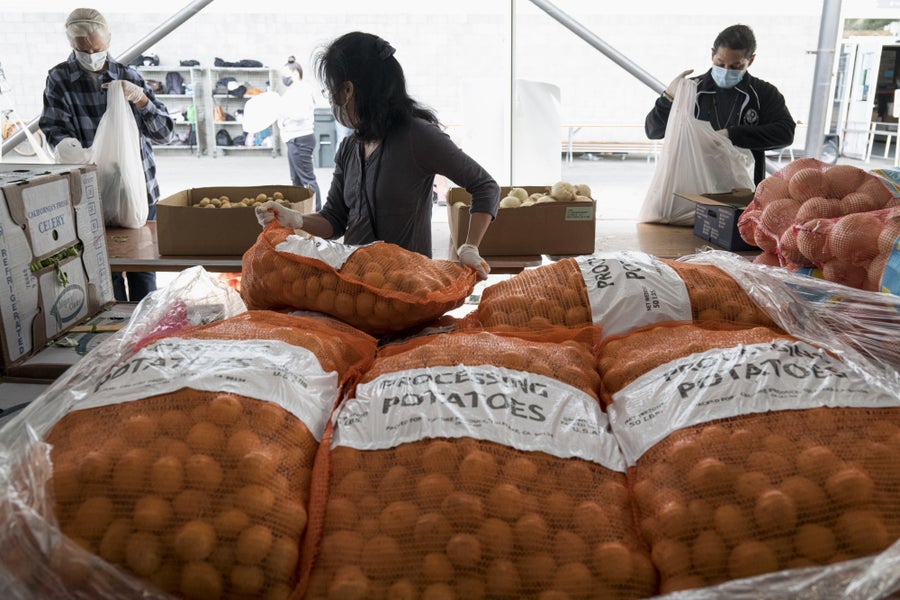
Volunteers stack bags of potatoes at the San Francisco-Marin Food Bank in San Francisco, Calif., on May 28, 2020. David Paul Morris/Bloomberg via Getty Images
.
.
Click the link below for the article:
.
__________________________________________
 James' World 2
Leave a comment