
Click the link below the picture
.
The brain is a mere piece of furniture in the vastness of the cosmos, subject to the same physical laws as asteroids, electrons, or photons. On the surface, its three pounds of neural tissue seem to have little to do with quantum mechanics, the textbook theory that underlies all physical systems, since quantum effects are most pronounced on microscopic scales. Newly proposed experiments, however, promise to bridge this gap between microscopic and macroscopic systems, like the brain, and offer answers to the mystery of consciousness.
Quantum mechanics explains a range of phenomena that cannot be understood using the intuitions formed by everyday experience. Recall the Schrödinger’s cat thought experiment, in which a cat exists in a superposition of states, both dead and alive. In our daily lives, there seems to be no such uncertainty—a cat is either dead or alive. But the equations of quantum mechanics tell us that at any moment the world is composed of many such coexisting states, a tension that has long troubled physicists.
Taking the bull by its horns, the cosmologist Roger Penrose in 1989 made the radical suggestion that a conscious moment occurs whenever a superimposed quantum state collapses. The idea that two fundamental scientific mysteries—the origin of consciousness and the collapse of what is called the wave function in quantum mechanics—are related, triggered enormous excitement.
Penrose’s theory can be grounded in the intricacies of quantum computation. Consider a quantum bit, a qubit, the unit of information in quantum information theory that exists in a superposition of a logical 0 with a logical 1. According to Penrose, when this system collapses into either 0 or 1, a flicker of conscious experience is created, described by a single classical bit.
Penrose, together with anesthesiologist Stuart Hameroff, suggested that such collapse takes place in microtubules, tubelike, elongated structural proteins that form part of the cytoskeleton of cells, such as those making up the central nervous system.
These ideas have never been taken up by the scientific community as brains are wet and warm, inimical to the formation of superpositions, at least compared to existing quantum computers that operate at temperatures 10,000 times colder than room temperature to avoid destroying superposition states.
Penrose’s proposal suffers from a flaw when applied to two or more entangled qubits. Measuring one of these entangled qubits instantaneously reveals the state of the other one, no matter how far away. Their states are correlated, but correlation is not causation, and, according to standard quantum mechanics, entanglement cannot be employed to achieve faster-than-light communication. However, per Penrose’s proposal, qubits participating in an entangled state share a conscious experience. When one of them assumes a definite state, we could use this to establish a communication channel capable of transmitting information faster than the speed of light, a violation of special relativity.
.
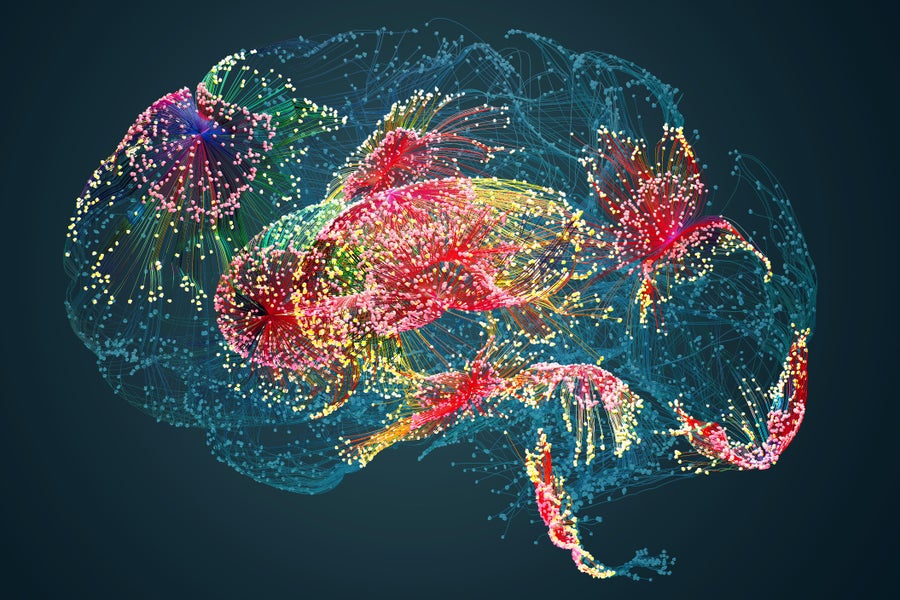 nopparit/Getty Images
.
.
Click the link below for the article:
.
__________________________________________
 James' World 2
Leave a comment