
Click the link below the picture
.
I’ve done the traditional barbell squat my whole life. It’s a great exercise for overall lower-body strength. I’ve also experimented with other squat variations: the front squat, the goblet squat, the belt squat.
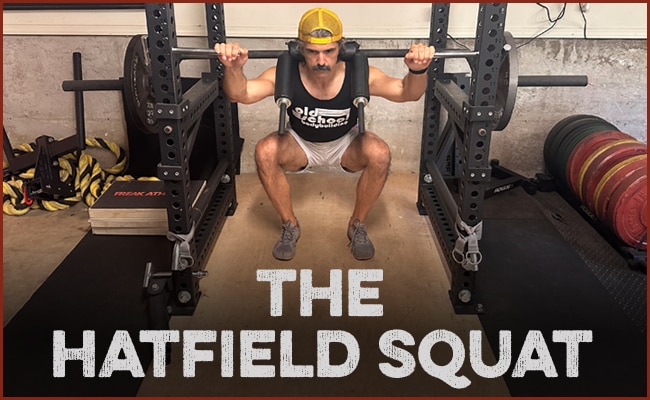
This year, I’ve been doing a squat that’s become my favorite ever: the Hatfield squat.
I love this exercise. I originally switched to it because long-standing problems with cranky shoulders and knee pain were making the traditional barbell squat uncomfortable. The Hatfield squat has made squatting fun and productive again after years of frustration trying to make the barbell squat work for me. What’s also great about the Hatfield Squat is that it’s an excellent movement for quad hypertrophy, which lines up nicely with my new fitness goal of getting more ripped. It’s been a game-changer in my training.
If you’ve had trouble with barbell squatting or are looking for a different squat variation to mix into your programming, here’s everything you need to know about the Hatfield squat.
What Is the Hatfield Squat, and What Are Its Benefits?
The Hatfield squat, named after powerlifting legend Dr. Fred Hatfield, aka Dr. Squat, is a back squat variation that requires a safety squat bar, which is a type of barbell that looks sort of like an ox yoke.
When you do the Hatfield squat, you place the safety squat bar on your back. Then, instead of holding on to the safety squat bar with your hands, you rest your hands on an additional barbell or a set of handles that have been placed at navel level on the barbell rack. As you descend into the squat, you keep your hands on the support in front of you, using it to maintain your balance and an upright torso.
This increases the stability of the exercise, allowing the Hatfield squat to offer some unique benefits:
Great for quad hypertrophy. If you’re looking to grow legs as big as tree trunks, the Hatfield squat can be a helpful tool. Its increased stability allows you to overload your quads more than a traditional squat. Instead of focusing on keeping your balance during the squat, you can just focus on the movement, which means you can be a bit more aggressive in adding reps or weight.
Great for squatting around injuries. The most significant benefit that the Hatfield squat has given me is that it has allowed me to squat heavy again despite the niggling physical issues I’ve had on and off for years.
Because I have shoulder tendonitis due to bench pressing and struggle with shoulder flexibility (despite the amount of time I’ve worked on developing this capacity), the bar position on the traditional low-bar squat just exacerbated my shoulder pain. Because you use a safety bar with the Hatfield squat, you don’t have to use your hands to hold the bar on your back. It completely removes the stress on your shoulders.
The Hatfield squat has also allowed me to work around some pain I’ve had behind my knee since 2020. The pain only happens during the descent part of a traditional barbell squat. I still don’t know what the source of the pain is despite talking to an orthopedic surgeon and getting an MRI done. I reckon it’s some sort of overuse injury on a tendon back there. But at any rate, the increased stability of the Hatfield squat allows me to squat heavy and below parallel without any pain behind my knee.
.
.
.
Click the link below for the article:
https://www.artofmanliness.com
.
__________________________________________
 James' World 2
Leave a comment