
Click the link below the picture
.
For many athletes, it is the pinnacle of their career. They have trained hard for years to take part in the Olympic Games. Winning a medal is a childhood dream for most of them—only surpassed by setting a new world record during the competitions.
And that happens again and again. At the Summer Olympics in Tokyo in 2021, existing world records were broken in several disciplines, six in swimming alone, mostly by a difference of tenths or even hundredths of a second. As in most Olympic sports, it’s all about precision: the slightest wrong move or external disturbance can make the difference between success and failure. Nevertheless, swimming stands out in one respect: It takes place in water, or more precisely, in a pool filled with water. And the shape of the pool can have a strong influence on the performance of Olympic athletes.
Before the start of this year’s Summer Olympics in Paris, hopes for new records were high. One of the reasons for this was new training techniques using “digital twins.” These are computer models of swimmers that mathematicians use to help the athletes achieve peak performance.
So far results for swimmers in Paris have been sobering. Only one world record had been broken as of August 1. And even worse: the Olympians seem to be falling far short of expectations. Nicolò Martinenghi, the winner of the men’s 100-meter breaststroke, only managed a time of 59.03 seconds—the slowest winning time in the event at an Olympic Game since 2004.
A cause was purportedly found: the Olympic swimming pool was not deep enough. A few days after the opening of the Games, the headlines were published: “Paris Olympics Swimmers Noticing Pool Is ‘Slow’ as Gold-Medal Times Don’t Come Near World Records,” “No World Records through Two Nights in Paris, Is the Pool in Paris ‘Slow’?,” “How Slow Paris Pool Is Thwarting Swimmers’ World Record Bids.” But can it be true? Is the pool really to blame for the lack of records? Anyone waiting for a “yes” or “no” will be disappointed. Unfortunately, there is no simple answer because the question is related to one of the most complex problems in mathematics.
The Paris La Défense Arena in Nanterre, a suburb of the city, is actually a rugby stadium and concert venue—Taylor Swift performed there in May—and has been converted into an indoor swimming pool for the Games. The huge pool will be dismantled afterward. This approach makes sense: during the summer Games, the many spectators are entitled to watch the athletes compete, but outside of these events, swimming pools with a grandstand that can accommodate 15,000 people seem completely oversize. This is why many Olympic swimming pools are designed to be temporary solutions.
What is surprising, however, is the depth of this year’s pool, which is unusually shallow at 2.15 meters. There is no standardized regulation as to what dimensions an Olympic pool should have. Until a few years ago, it had to be at least two meters deep, but now the minimum depth is 2.5 meters. A depth of three meters, however, is recommended. When construction of the Olympic pool started in 2017, the two-meter rule still applied. The pool in Nanterre is therefore permitted despite its comparatively shallow depth. And this, many are convinced, means that it is “slow.”
.
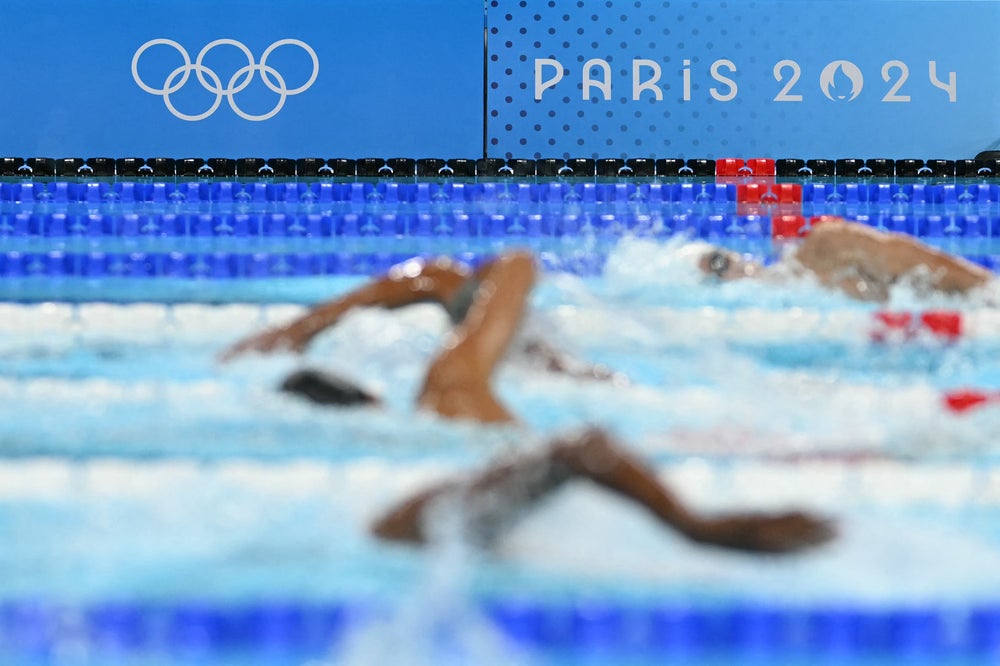
Swimmers compete during an event at the Paris 2024 Olympic Games at the Paris La Defense Arena. Jonathan Nackstrand/AFP via Getty Images
.
.
Click the link below for the article:
.
__________________________________________
 James' World 2
Leave a comment