
Click the link below the picture
.
Amid reports of record lows in unemployment for Black Americans and talk of “Black jobs” at June’s presidential debate, economic echoes of historical racism still resonate in the U.S. Today Black Americans face higher unemployment rates, lower earnings and deeper poverty than white Americans.
A legacy of injustice is most starkly evident in the economic disparities that persist in the places that were once plagued by lynchings.
In the 19th and 20th centuries, lynchings were widespread in the U.S., with more than 4,700 extrajudicial murders taking place from 1882 to 1968, according to the National Association for the Advancement of Colored People (NAACP). The 1955 murder of 14-year-old Emmett Till in Mississippi shocked the nation and galvanized the early Civil Rights Movement.
These horrific acts still shape the economic landscape of many counties where the lynchings occurred. Today the legacy of lynchings hurts Black Americans’ economic prospects, limiting upward mobility and perpetuating a cycle of poverty. This is more than a historical anecdote; it’s an ongoing reality backed by rigorous research.
How do we know that? For a study published in June in Kyklos, I and my colleague looked at economic opportunity levels for Black individuals in counties with the highest rates of historical lynching. The economic difference between these regions and counties without a lynching history is as large as that between New Orleans and San Francisco; the median income in the latter is more than 170 percent higher. This contrast is significant, given the U.S.’s reputation as the “land of opportunity.”
Previous research by others has shown the lingering effects of lynchings. A 2021 study found that families of lynching victims were still suffering psychologically and economically decades and generations later. “We went from prosperity to poverty overnight,” the 77-year-old daughter of a victim told that study’s authors. The same year, in a paper in Health & Place, researchers looked at life expectancy in 1,221 counties in the U.S. South and found it was lower in those with a history of lynching by more than a year on average, compared with counties with no recorded lynchings.
The notion that anyone, regardless of their background, can achieve economic success through hard work is a cornerstone of the American dream. These findings, however, reveal a different reality for many Black people in the U.S., whose economic prospects are still heavily influenced by the legacy of racial violence and discrimination. The promise of equal opportunity remains elusive, highlighting the need for continued efforts to address these deep-seated inequalities. How accessible is the American dream when historical injustices endure and blight today’s prospects for prosperity?
.
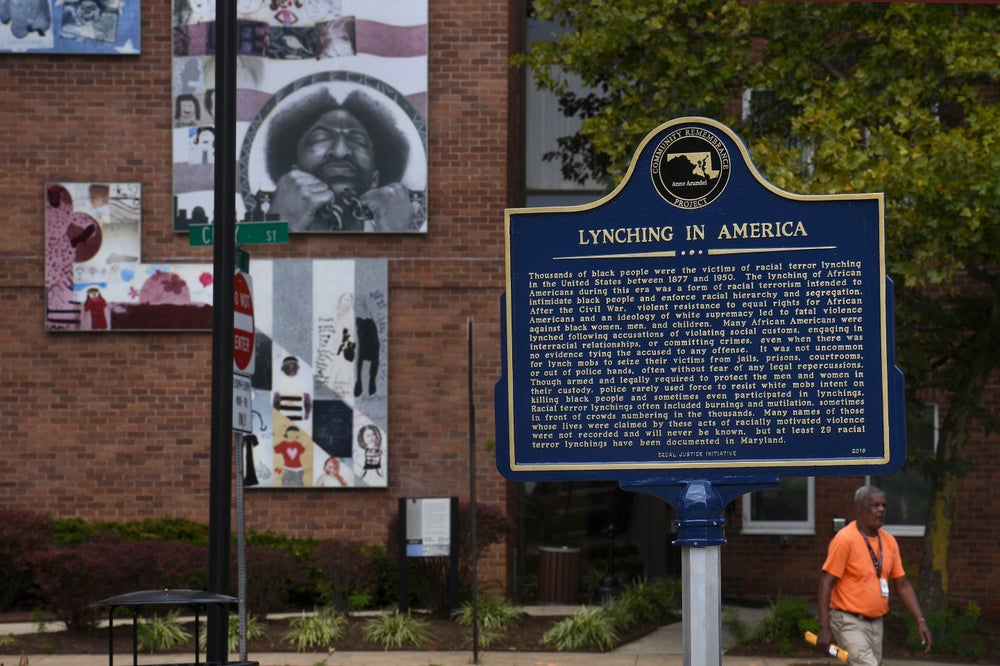
A historic marker detailing lynching in Anne Arundel County and in America at Whitmore Park on Calvert Street is seen September 17, 2019, in Annapolis, MD. Katherine Frey/The Washington Post via Getty Images
.
.
Click the link below for the article:
.
__________________________________________
 James' World 2
Jul 29, 2024 @ 01:30:25
True. Sad. Many of my ancestors were lynched in Montgomery, AL & surrounding areas.
LikeLike
Jul 29, 2024 @ 02:21:11
Yes, an anti-lynching law was recently passed.
LikeLike