
Click the link below the picture
.
James Lange remembers the day he and a team of botanists and conservationists gathered at a rock formation encircled by a thicket of mangroves in Key Largo, Florida. They’d come to the nation’s last wild stand of a rare cacti to confront the inevitable. With sea level rise bringing the Atlantic Ocean ever closer to the withering plants, the group had made the difficult decision to remove the cacti’s remaining green material, preserve it in nurseries, and hope that it might one day be reintroduced in the wild.
Three years later, research published last week reveals what Lange and the others long suspected: The demise of the Key Largo tree cactus is the first recorded case of sea level rise driving a local species to extinction in the United States. Its collapse was a blow to Lange, a research botanist at Fairchild Tropical Botanic Garden in Coral Gables who coauthored the study. “It was one of the things that made the Keys so special,” he said. “Just a big, bold, beautiful plant.”
Tree cactus is a suitable name for Pilosocereus millspaughii, known to reach towering heights, yield white flowers that entice nectar-hungry bats, and produce reddish-purple fruits for birds and mammals to feast upon. Although the cactus still grows on a few scattered islands in the Caribbean, it was restricted to a single population in North America, a thriving stand of 150 plants discovered in the Florida Keys in 1992. By 2021, just six ailing stems remained.
It is a monumental loss, scientists say, in no small measure because of what it signifies. Anthropogenic planetary warming is no longer solely endangering human communities. It is eradicating the very species that make up the fabric of our natural world.
“This existential threat that everyone’s aware of, seeing the actual evidence of it happening, giving an expectation of what we can expect moving forward, is important,” said Lange. He remembers how “everything was just looking horrible,” as the sea rapidly encroached on the cluster of plants. “We just knew there was no long-term hope for this population in this area,” he said. “There’s no shortage of plants in the Keys that are threatened with this same fate.”
From the critically imperiled Big Pine partridge pea to the jumping prickly apple, any number of coastal species in the Florida Keys could be wiped out next in one of the places most vulnerable to sea level rise. And unlike the Key Largo cacti, which survives, if only barely, elsewhere, several of them are the last of their kind.
“It’s very alarming,” said Marcelo Ardón, who studies coastal ecology at North Carolina State University. “Climate change is compounding all of these different drivers that makes these populations even more vulnerable.”
A major herbivory event, in which a substantial amount of the plants were eaten by animals, stressed the Key Largo cactus species in 2015. (Researchers suspect it might have occurred as a result of tidal flooding causing a shortage of freshwater, driving a gaggle of thirsty racoons or other wildlife to gnaw on the stems.) The threat was magnified by an ensuing series of recurring king tides, in addition to storm surge and damage wrought by Hurricane Irma. Jennifer Possley, lead author of the new study, considers it a possible “bellwether for how other low-lying coastal species will respond to climate change.”
.
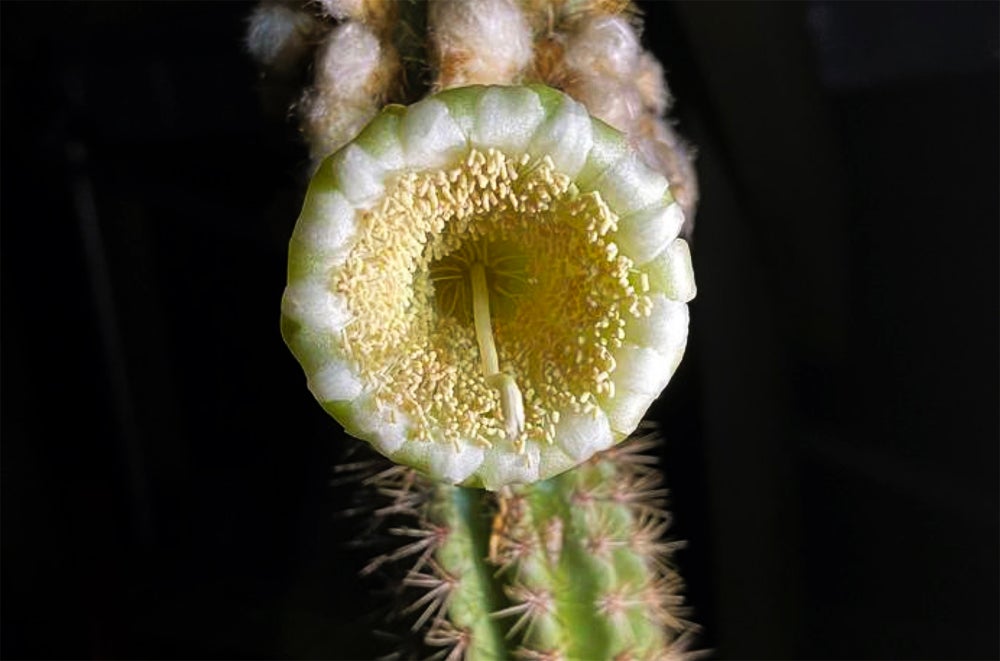
The Key Largo tree cactus was initially found growing in the United States in 1992 at a single site. That population has since been lost to a combination of rising sea levels and increasingly intense storms. Courtesy of Susan Kolterman
.
.
Click the link below for the article:
.
__________________________________________
 James' World 2
Leave a comment