
Click the link below the picture
.
“Dorothy” was deliberately fed to an Oklahoma F5 tornado about 30 years ago in the classic disaster movie Twister. The film followed storm-chasing scientists trying to use that special apparatus (a meteorological device containing hundreds of sensors and named after the tornado-jockey ingénue in The Wizard of Oz) to understand the inner workings of one of nature’s most fearsome phenomena. Now its just released stand-alone sequel, Twisters, follows another band of storm chasers who want to actually disrupt and dissipate these monster phenomena with today’s technology and knowledge.
Contrasting the two films shows how much tornado science has changed since the original flick, which featured radar and computer technologies that are now outdated. “We’ve come a long way since [Twister],” says Elizabeth Smith, a research meteorologist at the National Oceanic and Atmospheric Administration Administration’s National Severe Storms Laboratory (NSSL). And much of this progress has come through what she calls “the sum total of incremental change,” not singular projects like those depicted in the original movie. Some advances since then have in the decades transformed fiction into reality, enabling the latest film to explore even greater possibilities in managing and responding to dangerous weather events.
In the 1996 original, Helen Hunt’s character, Jo Harding, wanted to increase the warning times for tornadoes from three to 15 minutes by getting data from inside a funnel cloud to better understand how they work. And over the decades since, this science-fiction dream has turned into reality. “Now, when we issue a warning, the average lead time is 15 minutes,” says Harold Brooks, a senior research scientist at the NSSL. Though this may seem like a minor increase in the grand scheme of things, it offers considerably more time for people to reach shelter.
This improvement stems from a variety of new technologies, including more detailed radar readings and more powerful computers. But Smith says the most crucial development is computer models that can render storms in far greater detail—and can process observations much more quickly and accurately to better predict what those storms will do.
Early work in modeling focused on building a digital rendering of a storm from observational data—akin to Dorothy’s mission. But today’s tornado simulations are actually displaying never-before-observed aspects of the structure of tornadoes across different simulations. Storm chasers have later validated these phenomena in the field. “Instead of trying to go out and sample something to represent in the model, the opposite is now happening,” Smith says. “That’s a huge paradigm shift.”
Modern forecast models sometimes even predict tornado touchdowns more than an hour in advance. This extended warning time isn’t always helpful, though. “People tend to prioritize other activities over immediate safety with one to two hours of advance notice, which isn’t the reaction we want,” says Sean Waugh, a research scientist at the NSSL. A 2011 study found through public surveys that about 30 minutes is the preferred warning time, balancing urgency with enough lead time to get to safety.
.
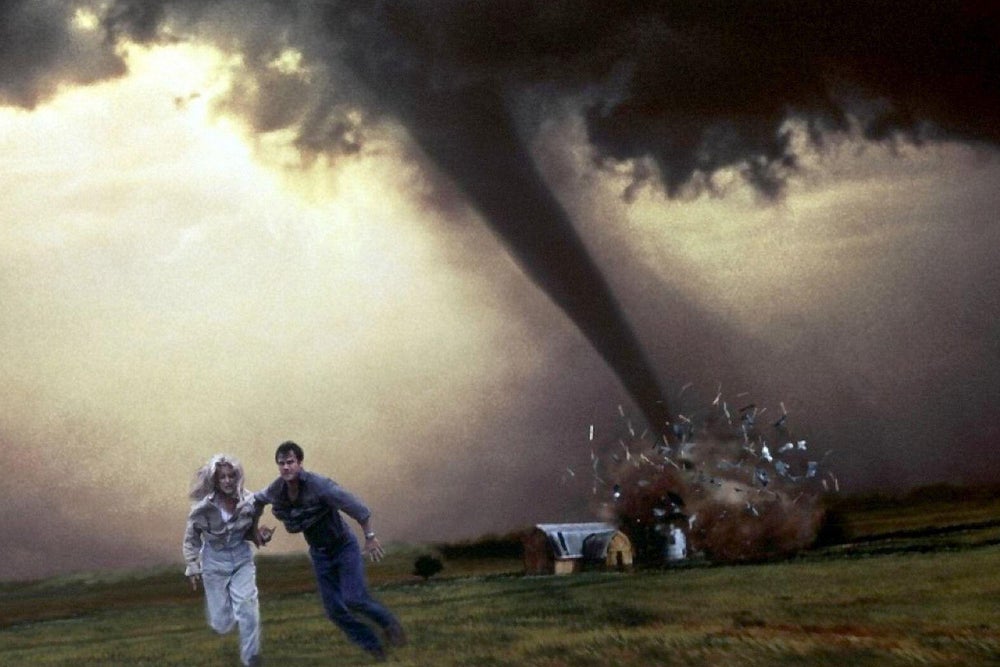
Helen Hunt and Bill Paxton as their characters Jo and Bill Harding in the 1996 movie Twister. Universal Pictures/Maximum Film/Alamy Stock Photo
.
.
Click the link below for the article:
.
__________________________________________
 James' World 2
Leave a comment