
Click the link below the picture
.
When Olivia Myers became pregnant with her first child, she was so nauseated that she had to either miss work or work from home in Calera, Alabama, from bed, with a trash can nearby. With her doctor, she attempted to ease the nausea and vomiting. She tried an anti-nausea medication, and then another and another — more than 10 different medications in all. A nurse came to her home to administer IVs to help with the dehydration from vomiting. She would walk around with a needle in her arm, wheeling around a pole that held the fluid slowly flowing into her body. She tried a Zofran pump — an anti-nausea medication that entered her body through a small needle she wore on her skin and a pump that she carried around in a backpack.
“It wasn’t working,” she says.
At her lowest point, when she was about 12 weeks pregnant and bedridden due to nausea and vomiting, she became terrified she wouldn’t be able to remain pregnant. “I was so scared that I was either going to miscarry or that I just wasn’t going to be able to do this for nine months,” she says. “I was having a mental breakdown.” Her husband considered taking her to the hospital on her worst day, a day she vomited 12 times.
Although most people experience some pregnancy nausea, an unlucky group that Myers belongs to experiences such severe nausea that can have serious effects on their bodies and lives. Myers had hyperemesis gravidarum, often known abbreviated as HG — severe pregnancy nausea characterized by a disruption in regular life, the inability to eat or drink regularly, weight loss, and sometimes malnutrition. It can become so severe that it can lead to miscarriage, organ damage, or death. About 0.3% to 2% of pregnancies are estimated to have severe HG. But pregnancy nausea and HG are on a spectrum, and even mild HG can be miserable.
Marlena Fejzo, a geneticist at the University of Southern California, was one of those unlucky 2%. Fejzo had HG in two pregnancies. Her first pregnancy, in 1996, left her with nausea and vomiting so severe she couldn’t work for two months, and she received IV treatments twice, The New York Times reported. In her second pregnancy in 1999, she became so malnourished from severe nausea and vomiting that she was put on a feeding tube. “I didn’t eat or drink for over a month,” she tells me. She miscarried at 15 weeks. When she came back to work after the loss, she told her boss she wanted to find the cause of HG. Her boss, the chair of the genetics department at the University of California, Los Angeles, laughed at her.
So for the next two decades, Fejzo researched HG in her free time, when she wasn’t researching ovarian cancer. “There was sort of a ‘don’t ask, don’t tell’ phase also where I worked on it on the side,” she says. “I couldn’t talk about it, really. It was a bit isolating — until recently.”
Fejzo started her first HG study in 2000 by posting a survey about pregnancy nausea on the Internet. Responders faxed their answers to her. One of the women who took the survey was Kimber MacGibbon, who had HG and went on to co-found the HER Foundation, dedicated to research, education, and support for those with HG.
.
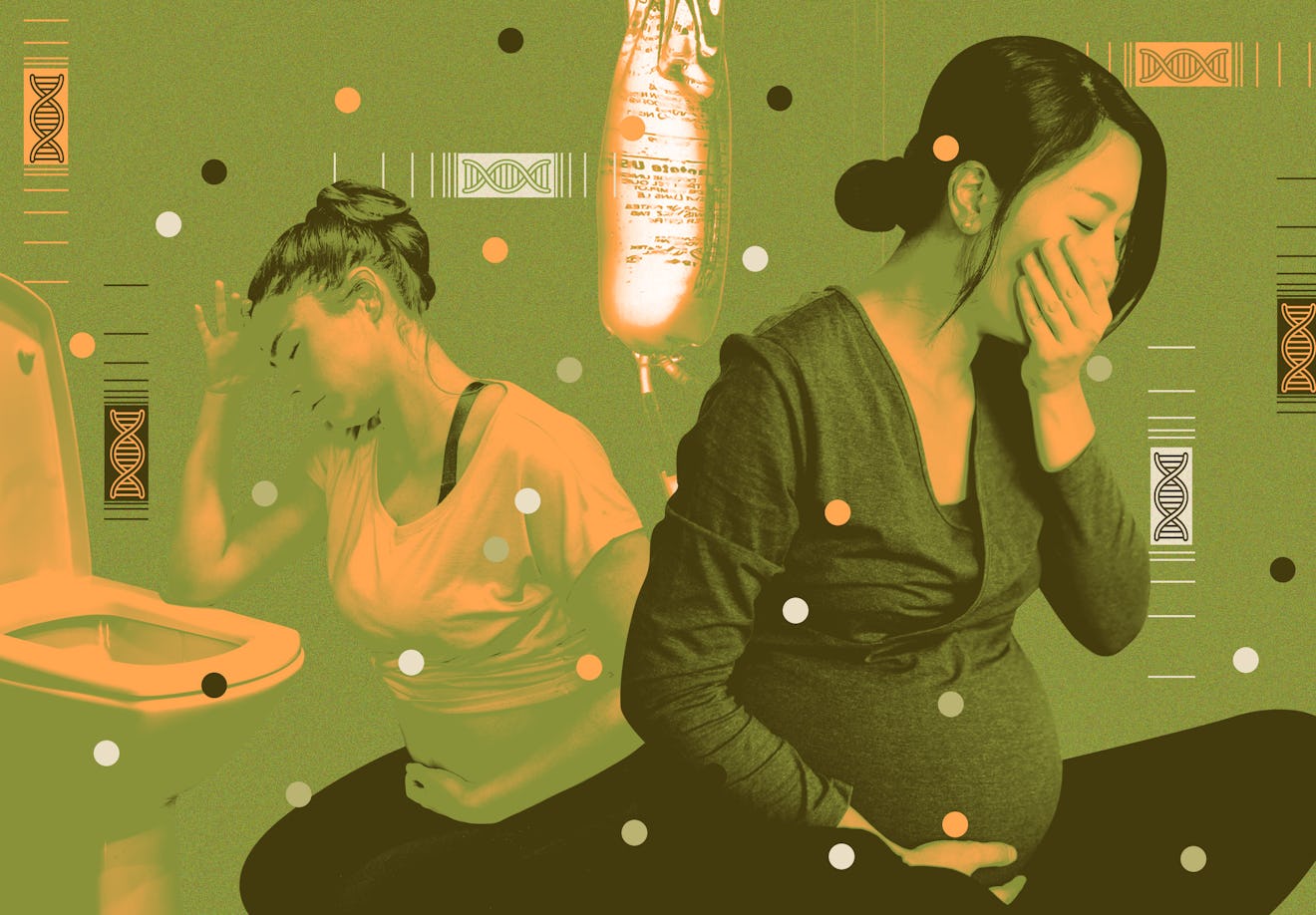 Hyperemis gravidarum, or HG, is a debilitating pregnancy nausea that affects 2% of pregnancies. Researchers know how to cure it — if they could only get funding.
.
.
Click the link below for the article:
.
__________________________________________
 James' World 2
Leave a comment