
Click the link below the picture
.
When the electric air taxi revolution arrives, you probably won’t, it hear coming. A remarkable feature of an electric vertical takeoff and landing (eVTOL) aircraft is how quietly it flies, scarcely noticeable amid typical city traffic sounds. Unlike a helicopter, there’s no pounding, 90-decibel “thwop, thwop, thwop.” In contrast, eVTOL aircraft use multiple small propellers that spin half as fast as a chopper’s rotor—avoiding the annoying, low-frequency sound pulses created by the big whirling blades.
Electric motors, which are quieter than helicopters’ turbine engines, also help keep any racket to a minimum. “The latest air taxi designs, such as those from leading builders like Joby and Archer, deliver a 20- to 25-decibel reduction in noise levels compared to helicopters,” says Mark Moore, the trailblazing engineer who led the development of NASA’s X-57 Maxwell electric airplane. That means that eVTOLs could be four or five times less noisy to nearby listeners. Beyond offering quieter flights, these new machines should also be significantly safer, greener, and cheaper to fly than helicopters. Moore maintains that electric air taxis are uniquely suited for what the aviation industry calls urban air mobility (UAM) services, enabling normally gridlocked travelers to “take advantage of the third dimension to escape the ant trails on the ground.”
More than two dozen major eVTOL builders have been founded in the past decade, and a few are nearing commercial certification from the U.S. Federal Aviation Administration or its European counterpart, the European Union Aviation Safety Agency (EASA). Each company is working on its own homegrown aircraft design, but all have the same goal: to provide on-demand air trips no longer than 18 to 25 miles—the “sweet spot” range for first-generation, battery-electric eVTOL taxis. These short, high-speed hops could carry commuters between city centers and airports or transport cargo and packages. Militaries may want eVTOLs for casualty evacuations or logistical supply. Other potential uses include air ambulances, donor organ delivery, and police transport, as well as scheduled shuttles and ecotourism trips—and, of course, personal flying cars.
Distributed Electric Propulsion
In 2016 Moore, who co-founded Uber Elevate, an air taxi offshoot of the ride-sharing company, and his colleagues outlined the emerging industry’s basic business model in a seminal white paper entitled “Fast-Forwarding to a Future of On-Demand Urban Air Transportation.” It galvanized the nascent UAM industry by declaring that the necessary technology had finally arrived. “What had previously been science fiction” was suddenly becoming a going enterprise, Moore recalls. Uber Elevate soon assembled potential players including budding airframe builders, airline companies, auto makers, and transport service providers, as well as potential financiers and operators of new vertiports—airports for vertical-lift aircraft.
.
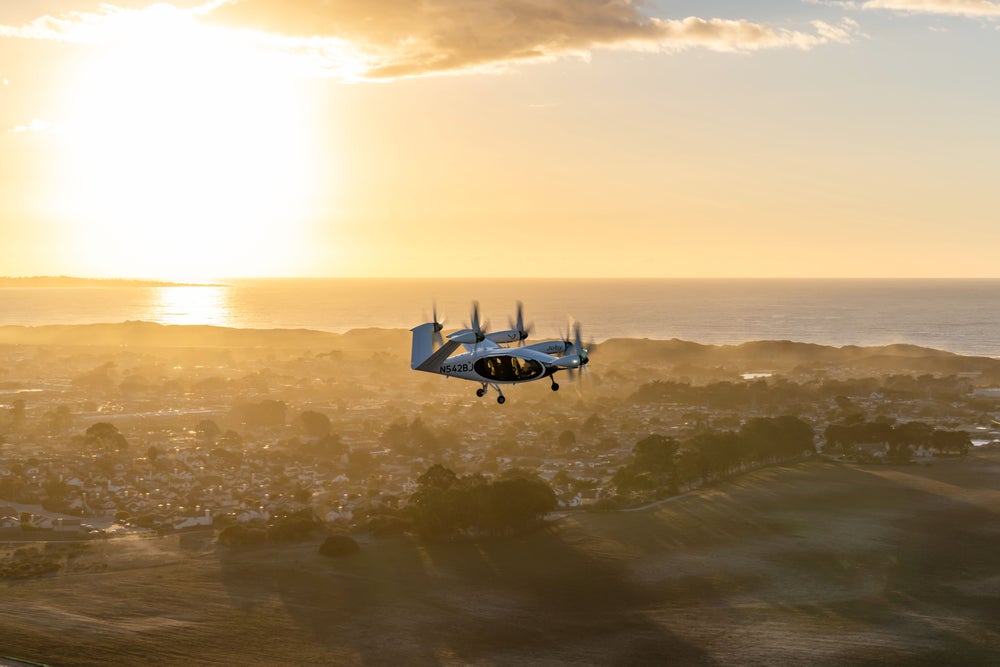
A flying electric air taxi developed by California-based Joby Aviation. Joby Aviation/© Joby Aero, Inc.
.
.
Click the link below for the article:
.
__________________________________________
 James' World 2
Leave a comment