
Click the link below the picture
.
NASA’s beloved Voyager 1 mission is back to normal science operations for the first time in more than six months, according to agency personnel. The announcement was made after NASA received data from all four of the spacecraft’s remaining science instruments.
The venerable spacecraft launched in 1977 and passed into interstellar space in 2012, becoming the first human-made object to accomplish that feat. Today, Voyager 1 and its twin, Voyager 2, are NASA’s longest-running missions. But the title has been challenging to hold on to for spacecraft that were designed to operate for just four years. The aging probes are stuck in the deep cold of outer space, their nuclear power sources are producing ever less juice, and glitches are becoming increasingly common.
Most recently, Voyager 1 faced a communications issue that began in November 2023. “We’d gone from having a conversation with Voyager, with the 1’s and 0’s containing science data, to just a dial tone,” said Linda Spilker, Voyager project scientist at NASA’s Jet Propulsion Laboratory (JPL), of the spacecraft’s troubles in an interview with Scientific American in March.
After more than six months of long-distance troubleshooting—Voyager 1 is more than 15 billion miles from Earth, and any signal takes more than 22.5 hours to travel from our planet to the spacecraft—mission personnel have finally coaxed Voyager 1 to gather and send home data with all its remaining science instruments, according to a NASA statement.
The fix required months of analysis to track the issue to a particular chip within the spacecraft’s flight data subsystem. That chip’s code couldn’t be relocated in one fell swoop, however, so mission personnel split the information chip into chunks that could be tucked into stray corners of the rest of the system’s memory. NASA began implementing the new commands in April. And in May the agency directed the aging spacecraft to resume collecting and transmitting science data. Voyager 1’s plasma-wave subsystem and magnetometer bounced back immediately. Its cosmic-ray detector and ow-energy-charged-particles instrument required additional troubleshooting, but both are now finally operating normally, according to NASA.
.
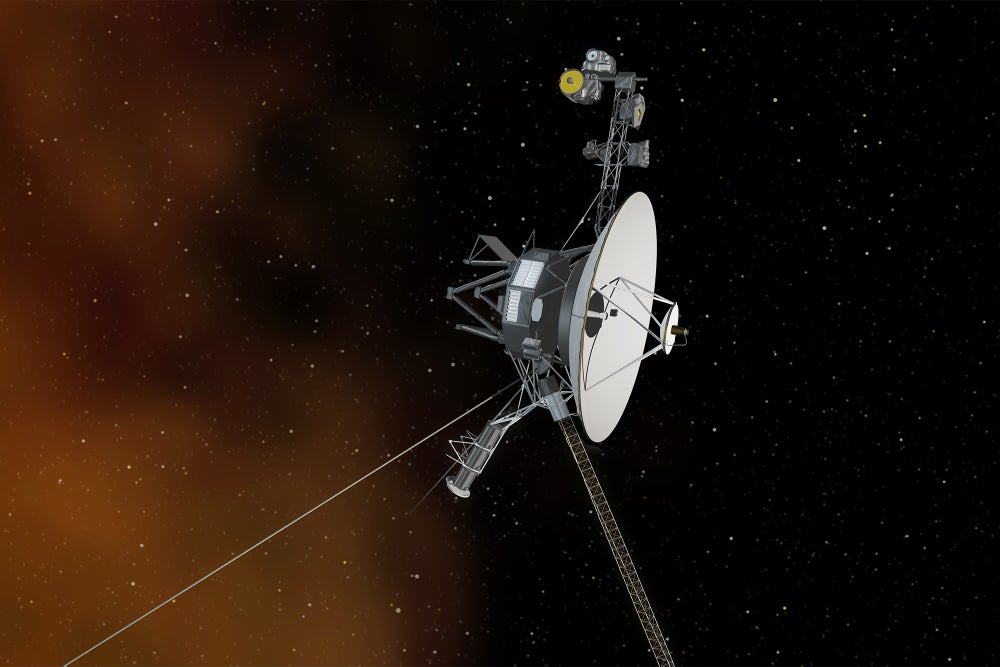
Artist concept of Voyager 1. NASA/JPL-Caltech
.
.
Click the link below for the article:
.
__________________________________________
 James' World 2
Leave a comment