
Click the link below the picture
.
CLIMATEWIRE | Hordes of giant viruses are living on the world’s second-largest body of ice — and may be slowing the impacts of climate change.
Scientists announced the discovery in a recent paper on the Greenland ice sheet. Some of the viruses, they say, have infected algae, potentially limiting the growth of colored snow blooms that can speed up ice melt and raise global sea levels.
“They infect the microalgae,” said Laura Perini, one of the paper’s lead authors and a researcher at Denmark’s Aarhus University. “If they kill the algae, … then they kind of reduce the speed with which the ice is melting.”
The Greenland ice sheet is the largest single contributor to global sea level rise. Algae can darken the surface of the snow, causing it to absorb more sunlight and melt at faster rates.
Researchers suspect that the newly discovered viruses help control that algal growth.
That theory isn’t yet confirmed — and scientists aren’t sure exactly how much algae contributes to melting on the Greenland ice sheet. But algal blooms are growing larger as the planet warms, Perini said, making it important to investigate the factors that affect their growth.
Since being classified in the 1980s, scientists have found giant viruses — or nucleocytoplasmic large DNA viruses — all over the world in soil, rivers, and oceans. Perini and her team wanted to find out if they also inhabited icy Greenland.
Researchers conducted genetic analyses on samples taken from the ice sheet. They found viral genes hiding in algal cells, indicating that the viruses have been infecting the algae populations for a while — likely hundreds of years.
Those pathogens are likely killing algae cells and obstructing the growth of blooms, though that was not investigated in the paper, said Frederik Schulz, a microbiologist at Lawrence Berkeley National Laboratory and one of the world’s top giant virus researchers.
“We have some examples that are reasonably well studied” of marine algal blooms, Schulz said in an interview. “Giant viruses play a role there in terminating the algae.”
If the viruses are keeping the algae population in check on the Greenland ice sheet, he said, that would mean they are allaying climate-driven global sea-level rise.
.
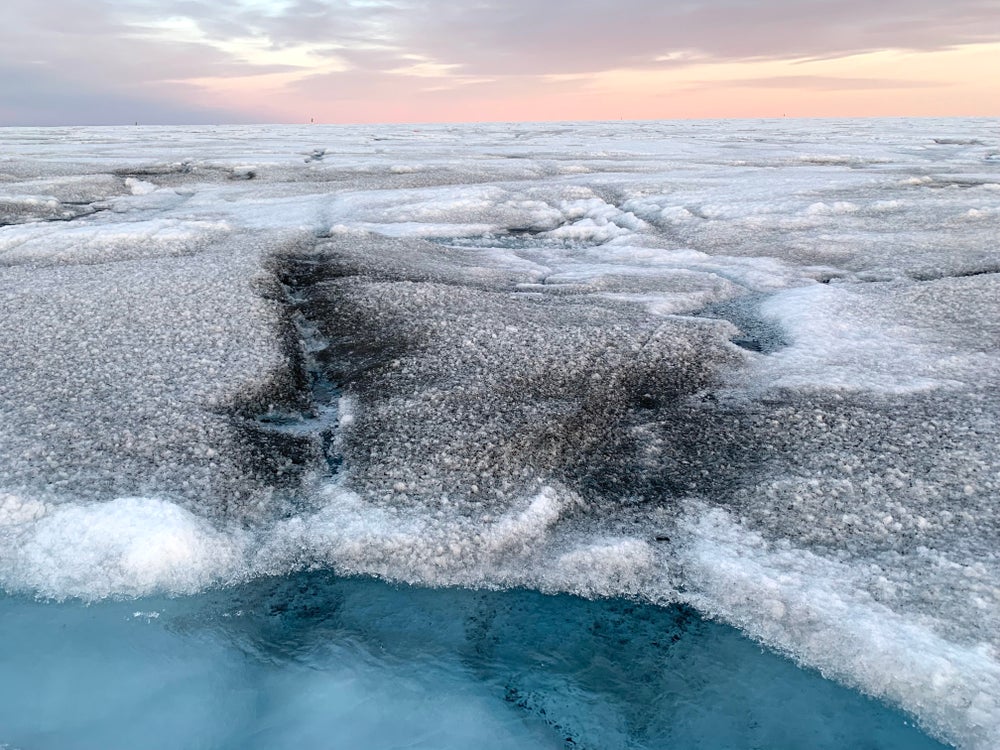
Several areas in Greenland are covered with black algae, which could speed ice melt by absorbing sunlight. Laura Perini
.
.
Click the link below for the article:
.
__________________________________________
 James' World 2
Leave a comment