
Click the link below the picture
.
University presidents and administrators can learn a lot from the student demonstrations that closed out this academic year.
Some lessons could be simply expedient. Most acutely: don’t get the chair of your philosophy department (in this case, me) arrested. That’s especially true when a video of her, looking like a model of respectability while being hauled off, might in the space of two days get 22 million views and become a serious public relations headache.
Another pragmatic lesson might be to clear encampments peacefully but quickly, since tents seriously interfere with commencement. More ambitiously, a president might try to negotiate with the demonstrators while simultaneously appeasing the governing board so as not to get fired.
Such lessons in expediency boil down to keeping their job while facing wrath from all sides, including Congress. To make matters worse, doing all this involves negotiating millennia of religious strife that overflows to this day, while somehow maintaining their reputation against charges of antisemitism or “complicity in genocide.”
As that arrested philosophy department chair, I’d like to propose a more visionary lesson: If university presidents want to be on the right side of history, they should study how democracy works and the role that universities play in aiding democratic processes. They should see their job as foremost to educate their students to become engaged members of society—with the side benefit of furthering the democratic process itself. They should avoid doing anything that slows down or reverses democracy.
Other lessons for aspiring visionary leaders: When appropriate, engage with the demonstrators. Treat them like budding civic actors, not enemies. If protests are peaceful, let them proceed. Consider going to REI and getting a tent to camp out with the students. Listen to those involved. If the discourse and chants strike you and your board or alumni as offensive, bring in some experts on constructive dialogue. Arrange for some deliberative forums.
But whatever you do, do not do what my university did on the morning of April 25, 2024. Do not bring in outside police forces armed with pepper spray, rubber bullets, and Tasers to violently and brutally dismantle a peaceful protest, all in a matter of minutes. Do not arrest bystanders like me and other professors and students who were calling for the police to stop and refusing to step away. Please don’t do any of that.
As a professor of political philosophy who has researched and written extensively on political deliberation and public life, the main lesson I’d like to impart is that this past season of protests is part of a larger political and democratic process. Such a season is not aberrant. Protests have a long and venerated history, and they are central to a well-functioning democracy. My book Fear of Breakdown: Politics and Psychoanalysis identifies protesting as one of several democratic practices central to even the most minimally functioning democracy. Protesting is a process of naming and framing issues, setting the agenda for more deliberative bodies to take up.
.
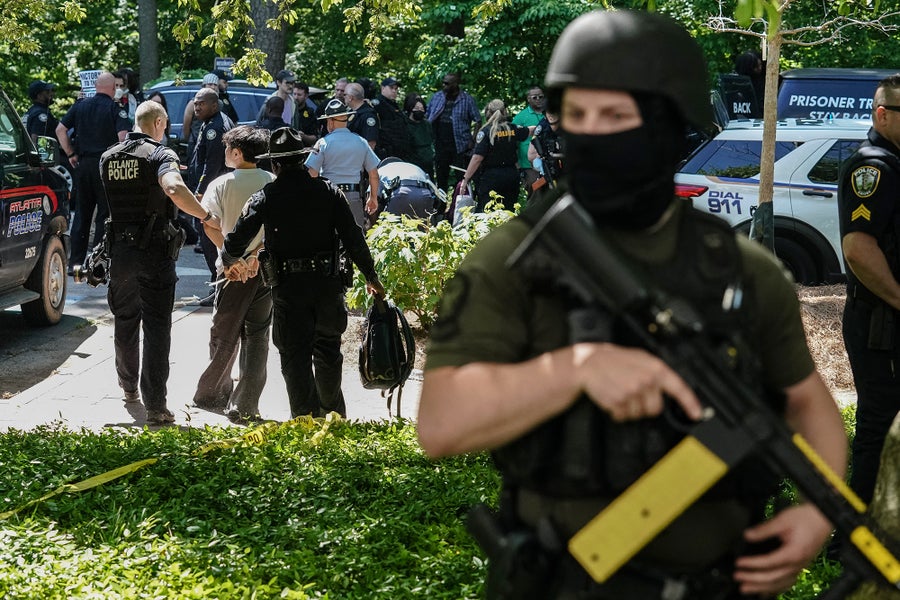
Police officers arrest a protester at Emory University in Atlanta, Georgia during a student led Palestine solidarity demonstration on April 25, 2024. Elijah Nouvelage/AFP via Getty Images
.
.
Click the link below for the article:
.
__________________________________________
 James' World 2
Leave a comment