
Click the link below the picture
.
The peppered moth is an iconic example of Charles Darwin’s theory of evolution by natural selection. For centuries, peppered moths (Biston betularia) were common in the forests around Manchester, England, and elsewhere. With their light-colored wings, peppered moths were camouflaged from predators against the light-gray bark of the trees they rested on during the day. By the early 19th century, however, soot from the industrial revolution had forged a new evolutionary environment, one that favored dark-colored moths, which matched the soot-covered trees better than their lighter peers. In the 1950s and 1960s evolutionary biologists found that in industrial areas, 80 percent of the moths were dark-colored, and the dark moths had a 2:1 survival advantage over light-colored moths in those areas. Today, in our age of molecular genetics, we know the mutation that probably produced the dark-colored moths occurred around 1819 and was the result of “jumping genes”—bits of DNA that change position in a genome and may create a mutation in the process.
The darkening of the peppered moth is also an example of anthropogenic evolution: evolutionary change caused by alterations humans make to the environment. In recent years, scientists have identified many more cases of human-mediated evolutionary change. The full scope and effects of anthropogenic evolution are only now coming into focus. But already we have ascertained that humans are shaping the evolutionary trajectories of animals across the globe, from insects to whales. As a result of our influence, key aspects of animal behavior are changing, including where they live, where they breed, what they eat, whom they fight, and whom they help. We are remodeling more than just the environments species live in. We’re altering the species themselves as they evolve in response to our impact on their surroundings.
One consequence of this change is that we are creating mismatches between animals and the settings in which they evolved. Creatures once well equipped to meet the challenges of their environment suddenly face a world in which their fine-tuned behavioral adaptations are no longer adaptive at all. In some species, natural selection is recalibrating behavior so that individuals are better suited to their new circumstances. The question is whether it will be able to do so fast enough to keep pace with human transformation of the planet we all share.
For long stretches of evolutionary time, natural selection has favored a tight link between ambient temperature and the start of the breeding season for many animals, including birds. Hormones associated with reproduction kick into gear when the weather warms; birds court, construct nests and bring food home to deposit into the mouths of their waiting young. For Tree Swallows (Tachycineta bicolor), the spring thaw is the trigger that sets that reproductive cascade into motion. But that trigger is now being pulled too early. Largely as a result of increased carbon dioxide emission, the average spring temperature for Tree Swallows living in northern New York increased about 1.9 degrees Celsius between 1972 and 2015, and the spring thaw is starting earlier. Over that same period, Tree Swallows started breeding 13 days earlier. The environmental cue the birds use to time breeding has become mismatched with their altered conditions.
.
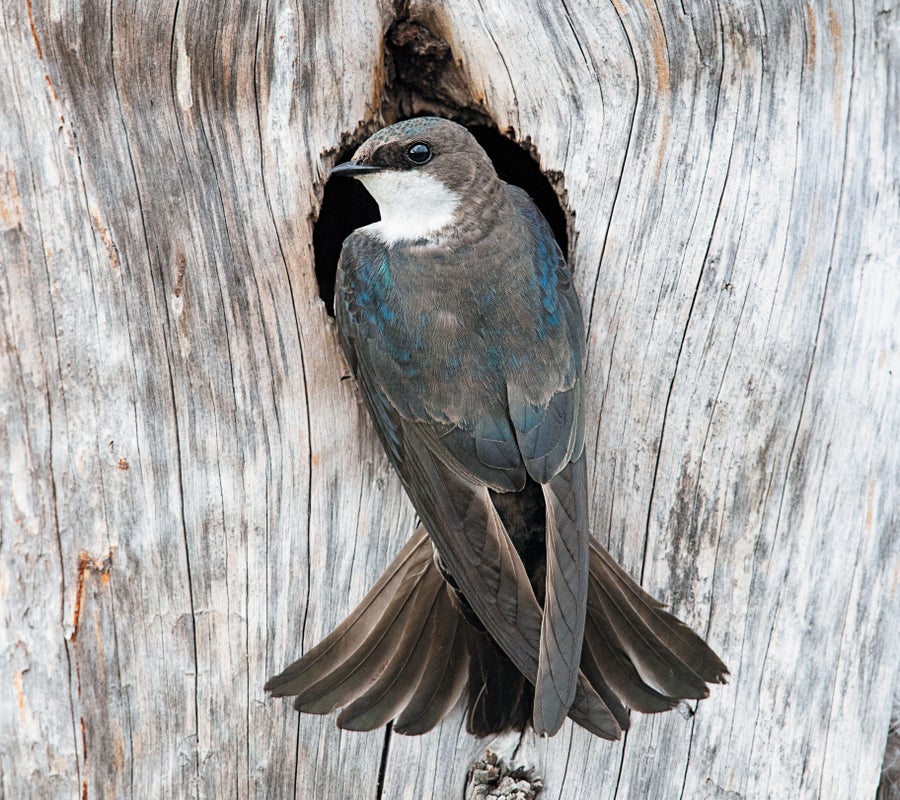
Tree Swallow. Donald M. Jones/Minden Pictures
.
.
Click the link below for the article:
.
__________________________________________
 James' World 2
Leave a comment