
Click the link below the picture
.
CLIMATEWIRE | The world still isn’t sucking enough carbon dioxide out of the atmosphere to meet the Paris climate targets, scientists said Tuesday. And the gap grows wider every year that humanity delays meaningful cuts to global greenhouse gas emissions.
That’s the punchline of a new report on the state of global carbon dioxide removal, the practice of drawing CO2 out of the air to help tackle climate change. It’s an update to the report’s first edition, which was published in January 2023.
Nations worldwide are scrubbing about 2 billion metric tons of carbon dioxide each year, mainly by planting trees, the report says. But experts estimate they’ll need to remove at least 7 billion tons annually by midcentury.
Meanwhile, global emissions must fall rapidly to stay on the Paris track. Humanity spews nearly 40 billion metric tons of carbon dioxide each year through the burning of fossil fuels.
Scientists agree the primary strategy for tackling climate change is through a reduction of greenhouse gas emissions, mainly by phasing out fossil fuels and halting deforestation. But they also agree at least some carbon removal is necessary to keep global warming below 1.5 or 2 degrees Celsius, the major goals of the Paris Agreement.
That’s because global emissions must reach net zero within a few decades to meet the Paris timeline, meaning any remaining carbon going into the atmosphere must be counterbalanced by an equal amount coming out.
Carbon dioxide removal, or CDR, is the “only way really to provide a balance of net zero if we still have residual emissions in the system,” said Steve Smith, a climate science and policy expert at the University of Oxford and a lead author of the new report, at a press conference Tuesday.
The simplest way to hit net zero is to stop pouring carbon dioxide into the air. But some sectors of the economy likely cannot be fully decarbonized within the next few decades, either because the technology doesn’t exist yet or it can’t be scaled up quickly enough.
That means some residual emissions will be leftover by midcentury, and world leaders will need to offset them with carbon removal.
There are a variety of ways that can be done. Planting forests is the most popular strategy today, accounting for nearly all the carbon removal happening around the world. But researchers are working on a range of novel techniques on the side, from giant carbon-guzzling machines to special minerals that help the land or the ocean absorb more CO2.
.
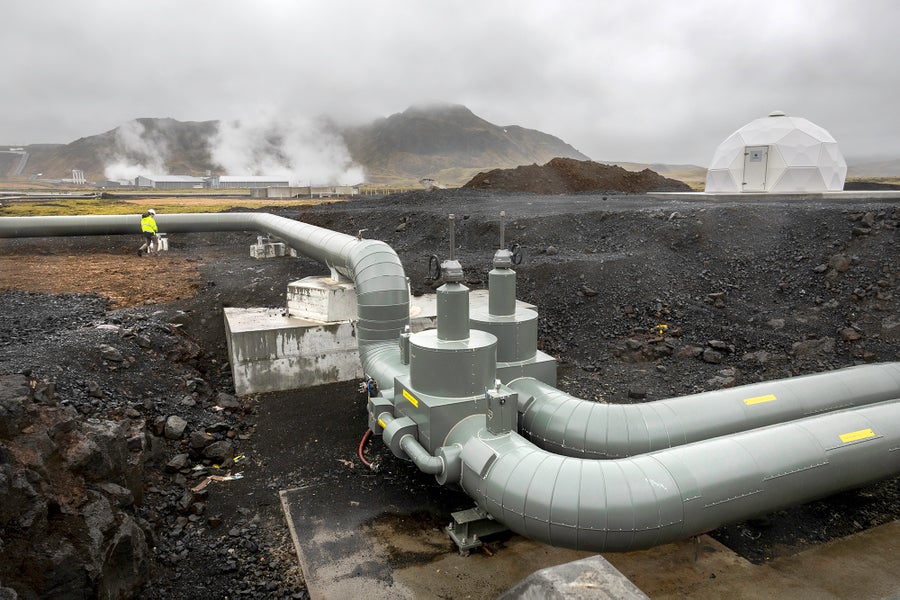
Mammoth carbon removal plant in Reykjavik, Iceland. John Moore/Getty Images
.
.
Click the link below for the article:
.
__________________________________________
 James' World 2
Leave a comment