
Click the link below the picture
.
A small, unassuming fern-like plant has something massive lurking within: the largest genome ever discovered, outstripping the human genome by more than 50 times.
The plant (Tmesipteris oblanceolata) contains a whopping 160 billion base pairs, the units that make up a strand of DNA. That’s 11 billion more than the previous record holder, the flowering plant Paris japonica, and 30 billion more than the marbled lungfish (Protopterus aethiopicus), which has the largest animal genome. The findings were published today in iScience.
Study co-author Jaume Pellicer, an evolutionary biologist at the Botanical Institute of Barcelona in Spain who also co-discovered P. japonica’s gargantuan genome, had thought that the earlier discovery was close to the genome size limit. “But the evidence has once again surpassed our expectations,” he says.
Genomic giants
The world’s genomic champion, which is native to New Caledonia and neighboring archipelagos in the South Pacific, is a species of plant called a fork fern. Its colossal number of base pairs raises questions as to how the plant manages its genetic material. Only a small proportion of DNA is made of protein-coding genes, leading study co-author Ilia Leitch, an evolutionary biologist at London’s Royal Botanic Gardens, Kew, to wonder how the plant’s cellular machinery accesses those bits of the genome “amongst this huge morass of DNA. It’s like trying to find a few books with the instructions for how to survive in a library of millions of books — it’s just ridiculous.”
There’s also the question of how and why an organism evolved to have so many base pairs. Generally, having more base pairs leads to higher demand for the minerals that comprise DNA and for energy to duplicate the genome with every cell division, Leitch says. But if the organism lives in a relatively stable environment with little competition, a gargantuan genome might not come with a high cost, she adds.
.
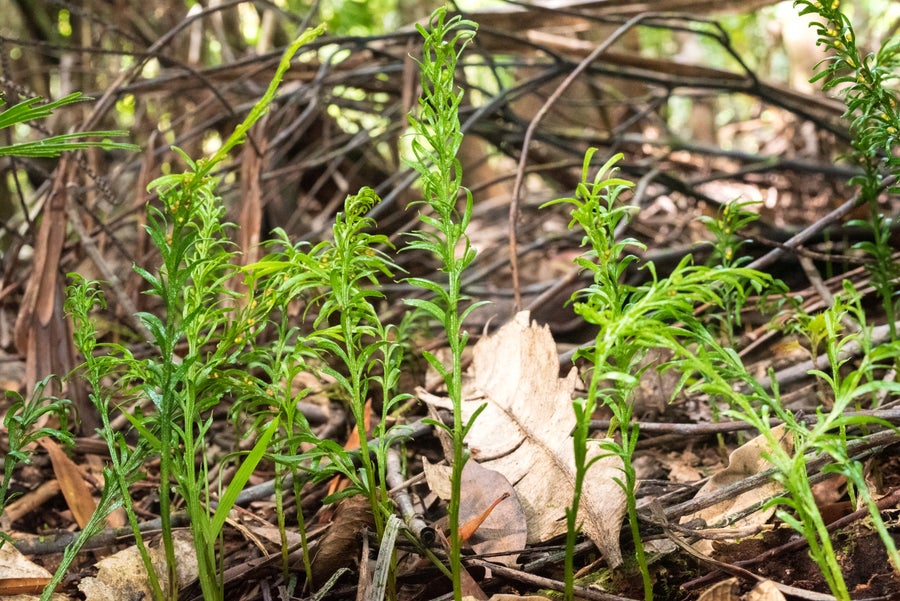
The record-breaking species Tmesipteris oblanceolata is easy to miss on the forest floor. Pol Fernandez
.
.
Click the link below for the article:
.
__________________________________________
 James' World 2
Leave a comment