
Click the link below the picture
.
Polaris, the North Star, is one of the most famous stars in the sky, but it’s also quite an enigma. A recent reappraisal of its basics—such as its mass and distance from Earth—suggests that the star is paradoxically youthful, appearing to be only a small fraction of its true multi-billion-year age, like a middle-aged human who somehow passes for a toddler. This is deeply strange; you’d probably assume astronomers have simply miscalculated this star’s age. But in fact, the truth may be even stranger: it turns out that stars can sometimes turn back the cosmic clock to rejuvenate themselves. And understanding how this may have happened for Polaris could prove crucial for nothing less than our conception of the universe itself.
To explain this enigma, the first thing to know is that Polaris is actually a multistar system in which several stars orbit one another. Even a quick glance through a small backyard telescope will reveal Polaris to be two stars: a bright one called Polaris A and a fainter one quite close to it called Polaris B. More sophisticated observations further reveal that the brighter star is itself actually a very tight binary consisting of two stars (called Aa and Ab), which orbit each other so closely that they appear as one in most images.
Polaris Aa is a giant star and by far the brightest of the three—when astronomers talk about Polaris, they usually mean this star specifically. It’s also a very special kind of star called a Cepheid variable, one that grows brighter and then dimmer periodically. Polaris Aa changes in brightness by about 4 percent over the course of about four days. Cepheid variables are critical in astronomy: the length of time it takes them to go through a complete cycle of dimming and brightening is related to how much energy they emit. That means that if you can measure their variability, you can get their absolute brightness. Comparing that intrinsic brightness with how bright a star appears in Earth’s sky is a way of determining cosmic distances (because more distant objects look fainter). We can spot such stars in nearby galaxies, which means we can measure the distance to that galaxy, which is otherwise difficult to do! That’s a very big deal indeed.
Polaris is the closest Cepheid to Earth, which means that getting its distance is critical. With that value in hand, we can then use it to calibrate the distances to other, more distant Cepheids. The problem is, getting the distance to Polaris is hard! It’s a decently bright star and rapidly saturates the detectors of most modern telescopes. This, in large part, is why distance estimates for Polaris have varied pretty widely, from roughly 300 to 450 light-years, which is an unacceptably large uncertainty, given how important this star system is to our fundamental cosmic reckoning.
In 2018 a team of astronomers did something clever: the researchers assumed that the third star, Polaris B, is physically associated with Polaris A (a pretty solid bet) and observed it with the Hubble Space Telescope to measure its distance using a technique called parallax. The result, 521 light-years, is actually even more distant than the top end of the previous estimates for Polaris, so it was a surprise. But is it right?
.
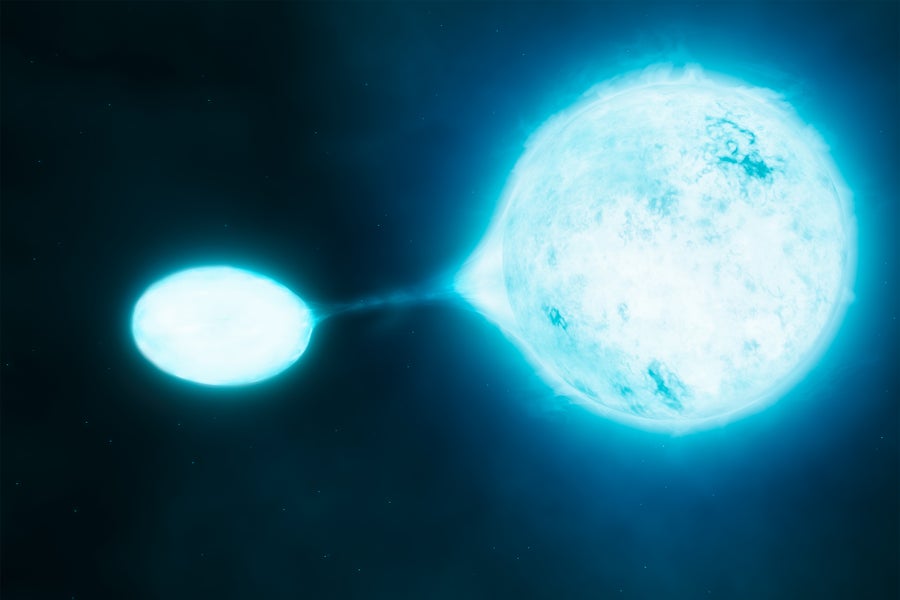
An artist’s impression of a massive star (right) feeding on a smaller companion star (left). ESO/M. Kornmesser/S.E. de Mink
.
.
Click the link below for the article:
.
__________________________________________
 James' World 2
Leave a comment