
Click the link below the picture
.
Europe’s upcoming Mars mission will use a pioneering nuclear-powered device that harnesses the radioactive decay of americium to keep its components warm — a first for spacecraft.
The European Space Agency (ESA) announced the plans on 16 May, alongside details of an agreement with NASA that crystallized the US agency’s contribution to the long-delayed ExoMars mission, which will deliver Europe’s first Mars rover, called Rosalind Franklin. ESA was originally working with the Russian space agency Roscosmos on the mission, but canceled the partnership in 2022, after Russia invaded Ukraine.
Radioisotope heater units (RHUs) harness the heat produced by the decay of radioactive elements to keep spacecraft warm enough to operate when it is not possible to use electricity generated by solar panels. ESA has historically relied on US or Russian partners to provide RHUs that use plutonium-238 for missions, but since 2009 has been working on its own program to create RHUs, as well as batteries that provide electricity.
The European RHUs will heat components of the mission’s landing platform, which deploys the rover onto the Martian surface. The lander powers the rover before it exits the platform and opens its solar panels. Heating the lander will extend its life, so it can provide backup in case there are issues when the rover is deployed, says Orson Sutherland, ESA’s group leader for Mars Exploration, who is based at the European Space Research and Technology Center (ESTEC) in Noordwijk, the Netherlands.
Americium decay
ESA’s heater units will not only be a first for Europe, but the first anywhere to use americium-241, a by-product of plutonium decay that packs less power per gram than does its precursor. But americium-241 is more abundant and cheaper — meaning that, even if the RHUs require more of the isotope, they might be less expensive overall. “Developing and launching a European RHU will be a first for ESA and a major achievement,” says Sutherland.
The Rosalind Franklin rover is uniquely equipped to search for traces of ancient life on Mars: it has a 2-meter drill that will allow it to burrow deep beneath the Martian surface. But the mission was originally slated for launch in 2018 and had already been delayed by technical issues and the COVID-19 pandemic, even before tensions escalated with Russia.
ESA had to radically rethink the mission to proceed without the involvement of Roscosmos, which was meant to build the lander. That led ESA to create a new European-designed lander and rely on NASA to fill the remaining holes in the mission plan. According to the agreement, NASA will provide capacity to launch ExoMars in 2028, as well as braking engines for the lander. NASA will also supply RHUs, for the rover.
.
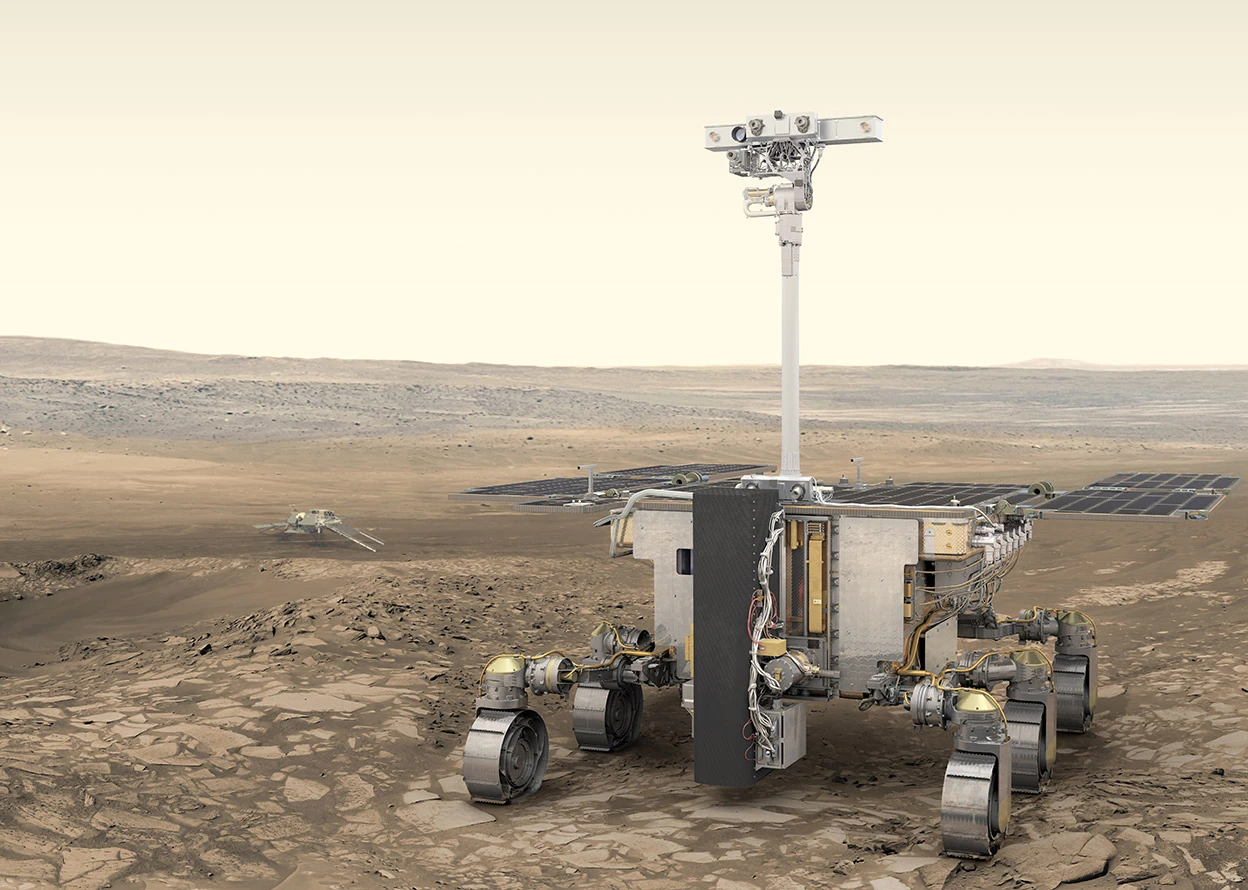 An artist’s impression of ESA’s ExoMars rover, Rosalind Franklin. Credit: ESA/ATG medialab
.
.
Click the link below for the article:
.
__________________________________________
 James' World 2
May 25, 2024 @ 08:48:42
💜
LikeLike