
Click the link below the picture
.
Black holes stretch the fabric of spacetime to its extreme—and the closer you get to one, the more warped things get. “You can be really very close to a black hole and, happily, circularly orbit,” says Andrew Mummery, a physicist at the University of Oxford. But as you draw nearer, a black hole’s gravitational grip becomes overpowering. You hit a precipice, and instead of peacefully circling, you simply fall.
At this point, classical orbital mechanics breaks down, and “[Isaac] Newton has nothing to say,” Mummery notes. Describing the dynamics of an object falling headlong down a black hole’s maw is a task for Albert Einstein’s general theory of relativity.
Einstein used this theory more than a century ago to predict what happens in what would later become known as black holes. Just outside a black hole’s event horizon—the boundary past which not even light can escape—an orbiting object will abruptly encounter a so-called plunging region and plummet to its doom at nearly the speed of light.
Theorists consider a black hole’s plunging region to be where the fate of all things falling in becomes sealed. Yet beyond that basic insight, this area has remained a near-total mystery. “Basically, the preexisting theoretical models ignored this region,” Mummery says—after all, it’s small and hard to see with current telescopes. But thanks to a chance outburst by a black hole feasting on matter in our galaxy, Mummery, and his colleagues have now observed the plunging region for the first time. They reported their results in a paper published last week in the Monthly Notices of the Royal Astronomical Society.
“The first time you see it, it’s just nice to know it’s there at all,” Mummery says. “Now that we know we can see this, there’s a lot of things we can, in principle, learn using it.”
.
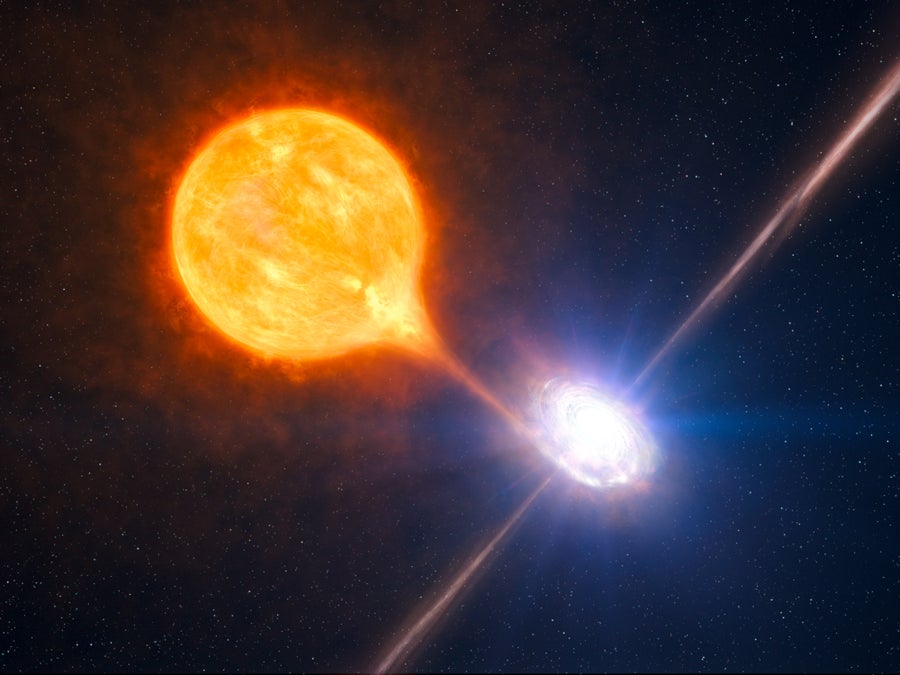
An artist’s concept of a stellar-mass black hole (right) siphoning material from a companion star (left). Much of the material forms an accretion disk around the black hole before falling inside. ESO/L. Calçada/M.Kornmesser
.
.
Click the link below for the article:
.
__________________________________________
 James' World 2
Leave a comment