
Click the link below the picture
.
A massive group of sunspots has produced the largest flare of the current solar cycle—but the stunning auroral spectacles that Earth enjoyed in recent days are unlikely to resume, experts say.
The sunspot cluster, known as active region 3664 (AR3664), broke a record on Tuesday when it emitted the largest flare to date of our sun’s current activity cycle. This X8.7-class flare peaked at 12:51 P.M. EDT, according to the National Oceanic and Atmospheric Administration’s Space Weather Prediction Center, which monitors the sun’s activity and its potential impacts on Earth.
A sunspot is a magnetic knot on the sun in which cooler temperatures make that part of the star’s surface appear darker than surrounding areas. These structures often produce solar flares—essentially huge flashes of high-energy light that, if pointed at Earth, can reach our planet in about eight minutes, sometimes trailed by slower-moving energetic particles that are also ejected by the blasts. Sunspots can also spark coronal mass ejections (CMEs), which are enormous clouds of charged plasma that can strike our planet within days of erupting from the sun.
At one point, this particular sunspot region stretched some 16 times the width of Earth. The size drew comparisons to the active region that produced the infamous 1859 Carrington Event, a massive solar storm that interrupted telegraph service worldwide and lit up our planet’s skies with auroral displays. A similar solar storm today could damage vital infrastructure such as power grids, communications systems and GPS navigation satellites. The impacts of AR3664 have been generally benign, however, despite the dramatic outbursts.
Beginning on May 7, AR3664 shot out a spree of half a dozen CMEs that started to reach Earth just after 12:30 P.M. EDT on May 10 and produced stunning auroras that night. The auroras occurred in both hemispheres and stretched as far from our planet’s poles as Puerto Rico and Mexico. The spectacle came with minimal downsides, although airplane flights were rerouted to avoid higher radiation levels near the poles, high-frequency radio systems experienced interference, and farmers who used precision GPS to steer tractors reported glitches as well.
.
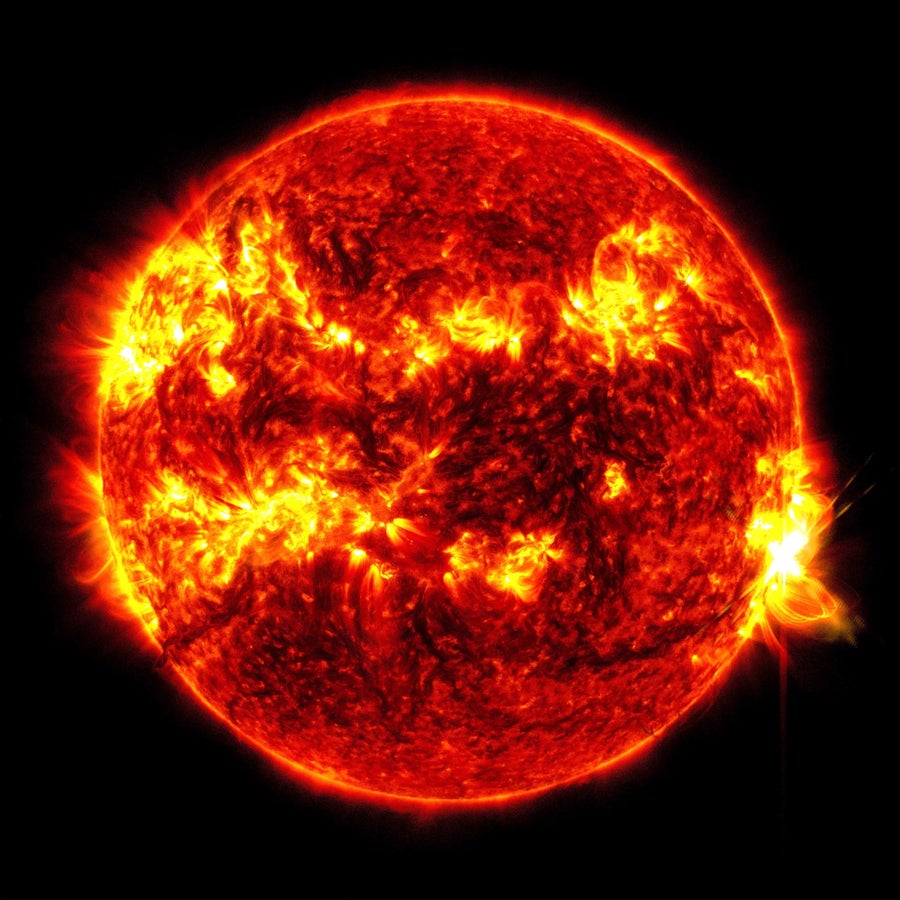
A massive solar flare that occurred on May 14, as captured by NASA’s Solar Dynamics Observatory spacecraft.
NASA/SDO
.
.
Click the link below for the article:
.
__________________________________________
 James' World 2
Leave a comment