
Click the link below the picture
.
At some point during the next several months, a distant, dead star will rapidly grow brighter in a powerful explosion, making it visible from Earth for a short period of time. To observers on the ground, it will look like a new star.
The dead star—which is currently not bright enough to appear in the sky—is one of a pair that orbit each other in a binary system called T Coronae Borealis, or T CrB. Known as a white dwarf, this leftover stellar core is snatching material from its neighboring red giant. When it gathers enough, roughly every 80 years or so, the white dwarf releases energy in a bright outburst, according to NASA.
Astronomers excitedly await the short-lived event. “When T CrB goes off, a large fraction of every telescope in the world is going to be pointed at it,” Bradley Schaefer, an astrophysicist at Louisiana State University, tells Scientific American’s Robin George Andrews.
T CrB is located 3,000 light-years from Earth. The astronomer John Birmingham observed its outburst from western Ireland two explosions ago, in 1866, according to Nicole Mortillaro of the Canadian Broadcasting Corporation (CBC). Then, it flared up again in 1946. There’s also evidence that it was seen in 1787 and 1217, per the New York Times’ Robin George Andrews.
Such an event is called a nova—a rapid increase in the brightness of a white dwarf that reignites after years of slumber. These outbursts are different than supernovae, which are much more dramatic. Supernovae occur when a dying star erupts in a release of energy that can briefly outshine galaxies.
In systems like T CrB, a white dwarf is locked in a dance with a red giant, a star that has run out of fuel and begun to die. The red giant swells in size, its temperature and pressure increasing, and starts to eject its outer layers. A lot of this material is hydrogen gas, which gets slurped up by the white dwarf. Eventually, the white dwarf grows hot enough on its surface—a temperature of about 10 million Kelvin—to produce a nuclear explosion.
.
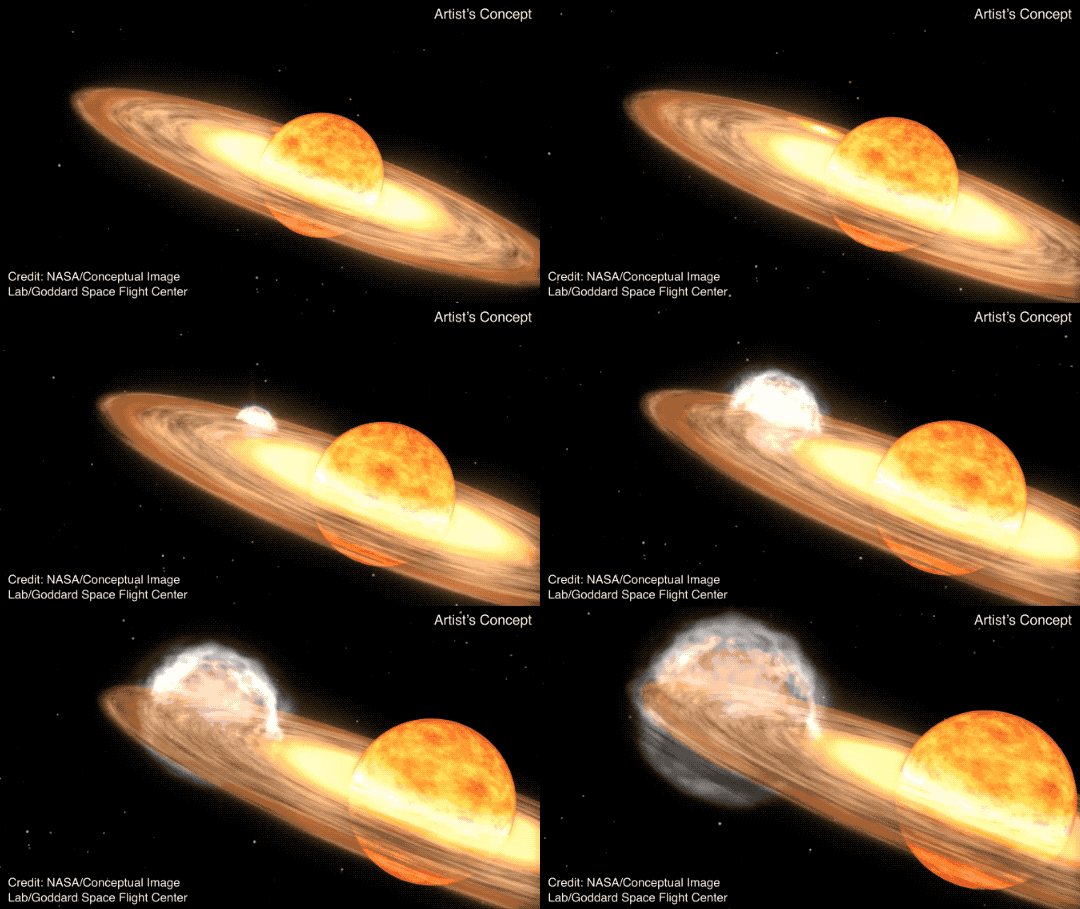 In an artist’s rendering, a red giant star and white dwarf star circle each other. Material ejected from the red giant gathers and heats in the white dwarf, catalyzing a bright explosion. NASA’s Goddard Space Flight Center
.
.
Click the link below for the article:
.
__________________________________________
 James' World 2
Leave a comment