
Click the link below the picture
.
Earlier this week, news broke that independent presidential candidate Robert F. Kennedy, Jr., claimed to have once had a dead worm in his brain. Kennedy had been experiencing memory loss and mental fog, and he originally suspected these symptoms might be caused by a brain tumor. Brain scans in 2010 showed a cyst that his doctors said contained remains of a parasite. The findings and other health issues were revealed in a New York Times article based on a review of a deposition for his 2012 divorce, as well as an interview the outlet conducted with him.
The revelation drew attention in the worlds of politics and parasitology. “I woke up to all kinds of messages from friends in parasitology,” says Shira Shafir, an epidemiologist and an associate adjunct professor at the University of California, Los Angeles, in response to the news.
The species of the purported parasite in Kennedy’s brain was never identified, and he did not know where he got infected. A spokesperson told media outlets on Wednesday that Kennedy had traveled extensively to Africa, South America, and Asia and likely contracted the parasite on one of the trips. Several parasites can affect the central nervous system and potentially create cysts in brain tissue. While relatively uncommon in the U.S., such infections can be devastating in many parts of the world. For example, the World Health Organization estimates there are between 2.56 million and 8.3 million people around the globe living with neurocysticercosis, a brain infection caused by the pork tapeworm Taenia solium. “It’s a really big deal in Latin America, sub-Saharan Africa, India, and other parts of Asia. It’s a leading cause of acquired seizures,” says Clinton White, a parasitologist and infectious diseases professor at the University of Texas Medical Branch at Galveston. “Neurocysticercosis is a major disease, and it’s kind of funny [these are] the circumstances in which people are paying attention to it.”
Scientific American spoke with Shafir and White to discuss how parasitic worms may infect the brain, what symptoms they cause, and how infections are diagnosed and treated.
What are parasitic worms, and which ones can infect the brain?
SHAFIR: We generally don’t have adult worms that end up in the brain. What does end up in the brain are parasites in their earlier developmental stages, such as eggs or larvae—or, for lack of a better word, baby worms. So generally the parasitic infections that can impact the brain are those of pathogens in early developmental stages, which, for the most part, accidentally make it into the brain.
.
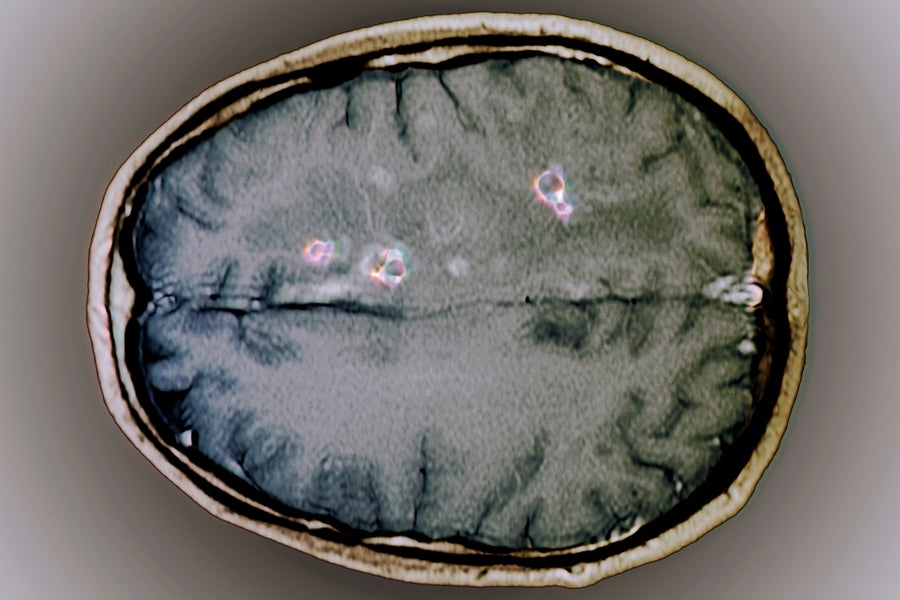
Magnetic resonance imaging (MRI) scan of an axial section through the brain of a 25-year-old patient, showing cysts (purple) from a tapeworm infection. Zephyr/Getty Images
.
.
Click the link below for the article:
.
__________________________________________
 James' World 2
Leave a comment