
Click the link below the picture
.
In October 2022 a bird with the code name B6 set a new world record that few people outside the field of ornithology noticed. Over the course of 11 days, B6, a young Bar-tailed Godwit, flew from its hatching ground in Alaska to its wintering ground in Tasmania, covering 8,425 miles without taking a single break. For comparison, there is only one commercial aircraft that can fly that far nonstop, a Boeing 777 with a 213-foot wingspan and one of the most powerful jet engines in the world. During its journey, B6—an animal that could perch comfortably on your shoulder—did not land, did not eat, did not drink, and did not stop flapping, sustaining an average ground speed of 30 miles per hour 24 hours a day as it winged its way to the other end of the world.
Many factors contributed to this astonishing feat of athleticism—muscle power, a high metabolic rate, and a physiological tolerance for elevated cortisol levels, among other things. B6’s odyssey is also a triumph of the remarkable mechanical properties of some of the most easily recognized yet enigmatic structures in the biological world: feathers. Feathers kept B6 warm overnight while it flew above the Pacific Ocean. Feathers repelled rain along the way. Feathers formed the flight surfaces of the wings that kept B6 aloft and drove the bird forward for nearly 250 hours without failing.
One might expect that considering all the time humans have spent admiring, using, and studying feathers, we would know all their tricks by now. Yet insights into these marvelous structures continue to emerge. Over the past decade, other researchers and I have been taking a fresh look at feathers. Collectively we have made surprising new discoveries about almost every aspect of their biology, from their evolutionary origins to their growth, development, and aerodynamics.
Among the creatures we share the planet with today, only birds have feathers. It makes sense, then, that for centuries scientists considered feathers a unique feature of birds. But starting in the 1990s, a series of bombshell fossil finds established that feathers were widespread among several lineages of the bipedal, carnivorous dinosaurs known as theropods and that birds had inherited these structures from their theropod ancestors. The discovery of feathered nonbird dinosaurs sent researchers scrambling to understand the origin and evolution of feathers, especially their role in the dawn of flight. We now know many dinosaurs had feathers, and protofeathers probably go all the way back to the common ancestor of dinosaurs and their flying reptile cousins, the pterosaurs. Bristles, fuzzy coverings, and other relatively simple featherlike structures probably decorated a wide array of dinosaurs—many more than we have been lucky enough to find preserved as fossils.
.
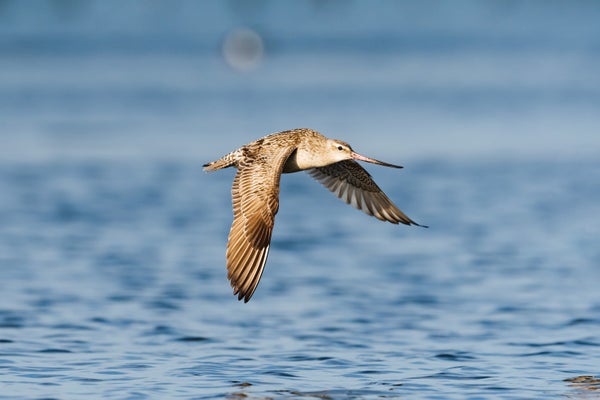 Bar-tailed Godwits undertake the longest nonstop migration of any land bird in the world. rockptarmigan/Getty Images
.
.
Click the link below for the article:
.
__________________________________________
 James' World 2
Leave a comment