
Click the link below the picture
.
Not long ago, the only way to tell whether a patient with dementia had Alzheimer’s disease was to do an autopsy for the presence of amyloid plaque and other signs of degeneration in the brain. In recent years, new tests can detect the presence of amyloid, a telltale protein of Alzheimer’s, and other biological signs long before the onset of symptoms. Soon, doctors may routinely make definitive diagnoses of Alzheimer’s with a simple blood test, even before symptoms of dementia become apparent.
An early diagnosis of Alzheimer’s is not worth much if there’s nothing you can do about it. But new effective treatments that slow the progress of the disease have become available: the drug lecanemab, recently approved by the FDA, and a new one called donanemab, which slowed cognitive decline in trials. The availability of effective treatments, together with technologies for detecting Alzheimer’s in the early stages, when those treatments can be most effective, have radically changed the outlook for Alzheimer’s patients and their loved ones. The notion of attacking Alzheimer’s in the brain before clinical symptoms emerge, long merely an aspiration, is starting to look like a practical strategy.
Advances in early detection and treatment come as welcome news, but they imply a looming public-health challenge. Being able to screen for Alzheimer’s and administer treatments before symptoms arise would vastly increase the number of people who need attention. Public-health institutions are almost universally inadequate for the task. There are large disparities in the impact of Alzheimer’s and in access to care in the U.S. and around the world. Pilot programs in communities around the world are showing how it might be done.
Meanwhile, the new optimism rippling through the research field is palpable. “Having been in this field for 20 years, the idea that I can finally offer treatments that biologically slow the disease is incredibly exciting,” says Gil Rabinovici, who directs the Alzheimer’s Disease Research Center at the University of California, San Francisco. “There’s a lot more work to do, but the feeling is that our understanding and ability to measure and treat the disease is coming together in a new way.”
An enormous toll
About one in nine Americans over 65 have Alzheimer’s disease, according to figures from the Alzheimer’s Association. The numbers are higher for several segments of the population, including women, Black Americans, and Hispanics. The number of people with Alzheimer’s is expected to more than double in 25 years.
It is a cruel, relentless disease. “It progressively robs you of who you are,” says neuroscientist Donna Wilcock, director of Indiana University’s Center for Neurodegenerative Disorders. Families carry much of the weight, she adds. The annual cost of Alzheimer’s care in the U.S. has reached $345 billion, the Alzheimer’s Association estimates—and that doesn’t count the $340 billion worth of unpaid care put in by an estimated 11 million family members and other caregivers of U.S. Alzheimer’s patients in 2022. Other estimates run even higher (see “The Ten Trillion Dollar Disease,” on page 24).
Modern medicine has made enormous strides in treating cancer, diabetes, heart disease, and even other neurodegenerative diseases such as Parkinson’s and multiple sclerosis. But for years, everything medicine could throw at Alzheimer’s seemed to bounce off. The main research strategy has been to try to come up with drugs that attack the plaque that for more than a century has been known to be present in the brain tissue of deceased Alzheimer’s patients. But the dozens of experimental drugs that reduced brain plaque in mice with Alzheimer’s-like symptoms failed to make any detectable difference in cognitive decline in human drug trials.
.
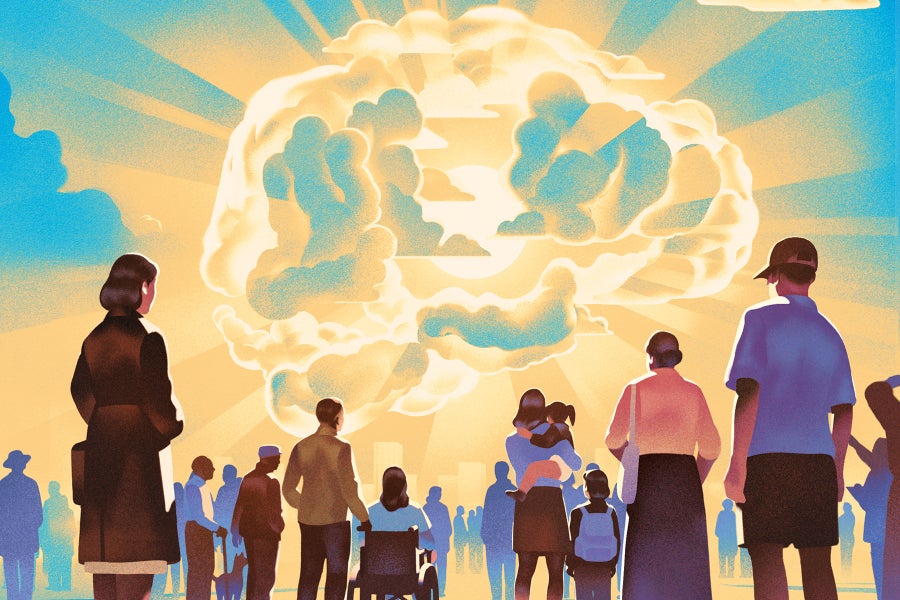
Recently approved therapies have given hope to the Alzheimer’s community worldwide. Harol Bustos
.
.
Click the link below for the article:
.
__________________________________________
 James' World 2
Apr 29, 2024 @ 15:18:20
It is a terrible disease, and I would not wish it on my worst enemy. My father had it.
LikeLike