
Click the link below the picture
.
On November 10, 2023, Kristín Jónsdóttir, head of the Icelandic Meteorological Office’s department of volcano research, was having a rare day off. “It was my 50th birthday,” she said. Then everything began to shake. She would spend the day staring at her phone, watching the earthquakes bloom across maps of Iceland’s Reykjanes Peninsula.
The peninsula experiences fissure eruptions, where the ground splits open and lava pours out. Since late October, attention had been focused on the peninsula’s Svartsengi region — home to the popular Blue Lagoon spa, a geothermal power plant, and the coastal town of Grindavík. The peninsula’s last three fissure eruptions had flooded isolated valleys with fire. Now, though, the town was under threat.
The maelstrom of temblors on November 10 revealed that a buried magmatic river had snaked its way toward Grindavík and its 3,600 inhabitants. More distressingly, a dike — a vertical magma body akin to a curtain of liquid fire — had fountained up from that subterranean river, stopping just shy of the surface.
Quickly, the authorities evacuated the town. And then everyone waited.
On December 18, a volcanic fissure cleaved the ground to the town’s northeast and painted the wintry soil with molten rock. The intense eruption lasted a few days and stayed outside Grindavík.
Then at 3 a.m. on January 14, the few residents who had returned to their homes were awakened by klaxons and text messages telling them to flee. Another eruption had invaded the town. By the time it ended 60 or so hours later, several houses had been engulfed, but no one had died.
Grindavík’s residents owe their lives to proactive local authorities, emergency managers, and the study of Earth’s interior. Scientists had been tracking the movement of magma by decoding seismic waves and distortions in the planet’s crust. By mapping the peninsula’s volcanic plumbing, they’re building a better understanding of how volcanism works in general, while also aiming to provide even more precise local forecasts in the future.
.
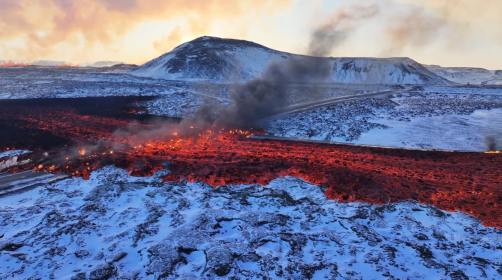 A 3-kilometer-long fissure opened up and sent a river of lava flowing over a road in southwest Iceland on February 8, 2024 — right on schedule. Hilmar Bragi Bárðarson
.
.
Click the link below for the article:
.
__________________________________________
 James' World 2
Leave a comment