
Click the link below the picture
.
Natural gas is a fossil fuel. Like other fossil fuels such as coal and oil, natural gas forms from the plants, animals, and microorganisms that lived millions of years ago.
There are several different theories to explain how fossil fuels are formed. The most prevalent theory is that they form underground, under intense conditions. As plants, animals, and microorganisms decompose, they are gradually covered by layers of soil, sediment, and sometimes rock. Over millions of years, the organic matter is compressed. As the organic matter moves deeper into Earth’s crust, it encounters higher and higher temperatures.
The combination of compression and high temperature causes the carbon bonds in the organic matter to break down. This molecular breakdown produces thermogenic methane—natural gas. Methane, probably the most abundant organic compound on Earth, is made of carbon and hydrogen (CH4).
Natural gas deposits are often found near oil deposits. Deposits of natural gas close to Earth’s surface are usually dwarfed by nearby oil deposits. Deeper deposits—formed at higher temperatures and under more pressure—have more natural gas than oil. The deepest deposits can be made up of pure natural gas.
Natural gas does not have to be formed deep underground, however. It can also be formed by tiny microorganisms called methanogens. Methanogens live in the intestines of animals (including humans) and in low-oxygen areas near the surface of Earth. Landfills, for example, are full of decomposing matter that methanogens break down into a type of methane called biogenic methane. The process of methanogens creating natural gas (methane) is called methanogenesis.
Although most biogenic methane escapes into the atmosphere, there are new technologies being created to contain and harvest this potential energy source.
Thermogenic methane—the natural gas formed deep beneath Earth’s surface—can also escape into the atmosphere. Some of the gas is able to rise through permeable matter, such as porous rock, and eventually dissipate into the atmosphere.
.
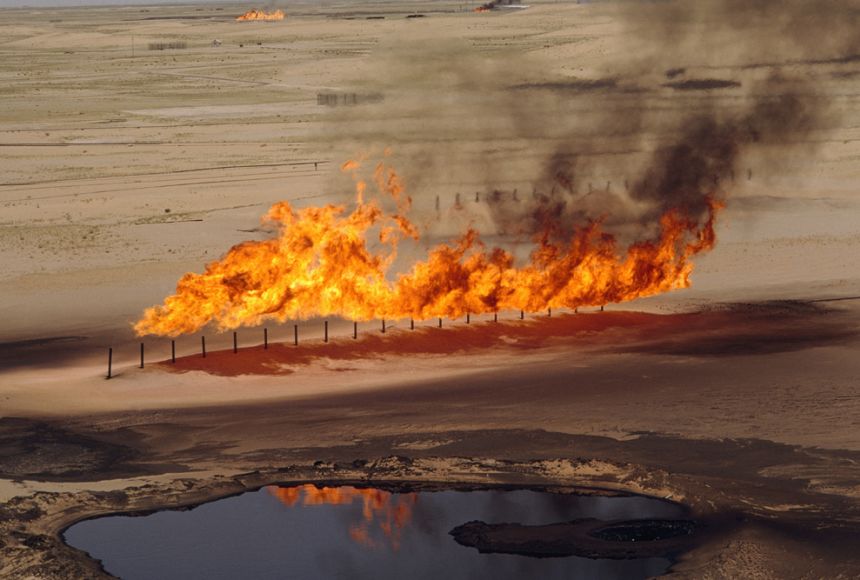 Photograph by David Cupp: Burgan Field/ The Burgan oil field, in Kuwait, is one of the richest oil fields in the world. Natural gas, some of which is seen burning here, is often found near deposits of oil and coal. Oil, coal, and natural gas are fossil fuels.
.
.
Click the link below for the article:
.
__________________________________________
 James' World 2
Leave a comment