
Click the link below the picture
.
“I feel betrayed on such a deep level.” Tamar Shamir read the message on her phone in surprise. Another followed: “I just want to puke.” Shamir, a 53-year-old peace activist, was at her home not far from Haifa, in northern Israel, on Oct. 8, the day after Hamas’s deadly attack. Already half-mad from grief, Shamir grew agitated as more angry messages streamed in, and other recipients signaled their agreement by adding heart emojis. Shamir was checking in on a WhatsApp group of young adult Israelis, members of a program Shamir often worked with called Young Ambassadors for Peace. Many of them had attended a summer camp that Shamir co-directs for teenagers from Israel and the West Bank, some of whom have lost loved ones to the decades-long conflict. They had compared sunburns at the beach, belted out songs from “Frozen” on karaoke night, stayed up late laughing, weeping, and sharing stories of their respective losses. Now the Israeli WhatsApp group was awash with hostility toward their Palestinian friends.
Shamir chain-smoked and paced around her house, phone in hand, forcing herself to follow the conversation. “I really don’t know how I can continue being in contact with those people,” she read. On social media, a Palestinian in the program had reposted a widely shared image of a Palestinian flag, alongside the date, Oct. 7, and a message in Arabic that translated to: “Officially the greatest day in the life of all of our generation.” One of the Israeli young ambassadors informed Shamir that she had seen an Instagram story from another Palestinian in the group with a visual of a flaming tank and an Israeli soldier dead beside it, accompanied by a laughing emoji. She told Shamir she was appalled.
Shamir could not bear the sense of finality of the messages. “It destroyed my heart,” she says. “I didn’t know what to do with it.” These were not just any friendships that were imploding; they were particular, carefully cultivated bonds. They were small and private, but they had been exceedingly rare footholds of mutual understanding. The project she held dear now seemed to be on the brink of collapse.
.
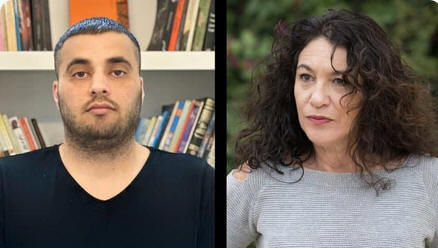
Ahmed Abu Jafar Tamar Shamir
“The Israelis would talk about peace with urgency, not as a luxury, because now they see how the war is painful,” Mohamed Abu Jafar says. Credit…Ahmed Abu Jafar
“They are not seeing what you are seeing on Israeli TV, and you are not seeing what they are seeing,” Tamar Shamir told a group of Israeli young people about their Palestinian friends. Credit…Yoss Stybel
.
.
Click the link below for the article:
.
__________________________________________
 James' World 2
Leave a comment