
Click the link below the picture
.
About a third of the food produced around the world goes to waste, and much of it ends up in landfills—where it becomes a source of methane, a greenhouse gas 25 times more potent than carbon dioxide. Eliminating waste is the ultimate solution, but food scraps will always remain. For that, there is a solution that nearly anyone can do: composting.
Composting turns rotting garbage into a valuable soil enhancer that helps plants thrive. Farmers call it “black gold.”
And now more cities are implementing curbside composting to help them meet their sustainability goals. New York is currently rolling out a mandatory composting program that will soon be effect in Brooklyn and throughout Manhattan by next year. Washington, D.C., and Chicago are piloting curbside composting programs, and Seattle and San Francisco have been successfully composting residents’ food scraps for years.
But you don’t have to wait for a city-wide program to begin composting in your backyard to taking food scraps to a community bin.
“Don’t be afraid of it. It’s relatively easy. It’s not without its missteps, but those are easily learned and corrected,” says Bob Rynk, lead author of The Composting Handbook and a professor emeritus at SUNY Cobleskill.
What happens in a compost pile?
Food turns into compost through the hard work of small microorganisms like bacteria, fungi, and protozoa.
“When you have a compost pile, you become a microbe farmer. You’re managing microbes,” says Rhonda Sherman, a composting expert at North Carolina State University. “And what do microbes need? They need the same things we do. Which is air, water, food, shelter.”
On a small scale, in your backyard or neighborhood, a compost pile should consist of three things: food scraps, water, and dry, woody material like yard trimmings or raked leaves.
Yard trimmings are frequently referred to as “browns” and are high in carbon. Food scraps are called “greens” and are high in nitrogen. A compost pile should typically have twice as many browns as it does greens.
.
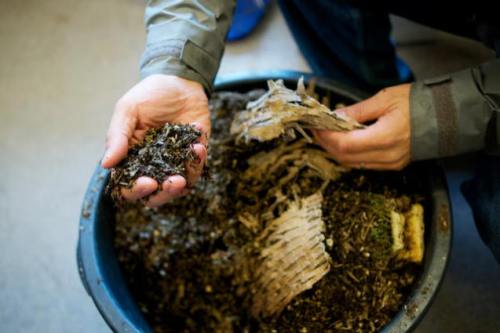
Compost is made from a mix of food scraps and yard waste such as raked leaves. When added to soil, it helps plants thrive. Photograph by Severin Wohlleben, laif/Redux
.
.
Click the link below for the article:
.
__________________________________________
 James' World 2
Leave a comment